


The Federation of Kenya Employers (FKE) has pushed back against proposed tax measures in Kenya’s 2026 Finance Bill, warning that workers are already taking home less pay as statutory deductions continue to rise.
Speaking on Thursday, FKE Chief Executive Jacqueline Mugo said employees and businesses alike were under growing financial strain. She argued that adding fresh taxes at a time of high living costs risked weakening household spending and slowing economic activity.
“We are calling on the government to see what can be done to alleviate the high level of statutory deduction on employees’ payrolls because that will also put pressure on businesses,” Jacqueline said.
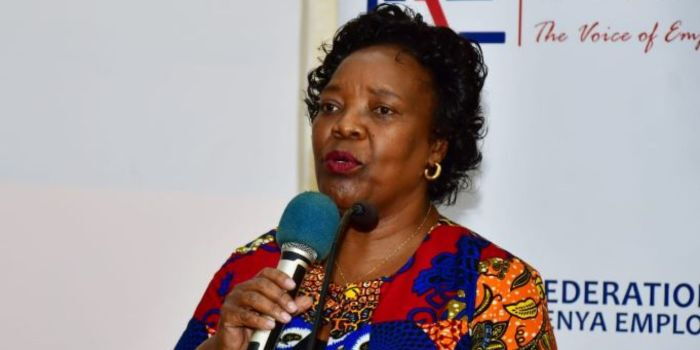
Image of the FKE CEO Jacqueline Mugo.
The employers’ lobby said it would formally submit its objections to the National Assembly’s Finance Committee on May 25.
At the centre of the dispute is a growing concern among employers that Kenyan workers are losing too much of their salaries to mandatory deductions, even as inflation and daily expenses continue to rise. Businesses, meanwhile, say they are grappling with higher operating costs, from taxation to energy and labour expenses.
The proposed Finance Bill also seeks to expand the powers of the Kenya Revenue Authority (KRA), allowing the tax agency to access certain personal and financial data in an effort to curb tax evasion and improve compliance.
But FKE warned that the move could cross privacy boundaries and expose ordinary Kenyans to unnecessary scrutiny.
“In regard to KRA, we want a situation where there is no increase in taxation and access to people’s data and related issues,” FKE CEO Mugo said.
The government has defended the proposals as part of broader efforts to widen the tax base and close loopholes used to underreport income. Officials argue that stronger enforcement is necessary as Kenya seeks to raise domestic revenue and ease pressure on public borrowing.
Yet the debate comes against the backdrop of earlier promises by the government to ease the burden on lower-income earners.
Earlier this month, Treasury Cabinet Secretary John Mbadi said plans to reduce Pay As You Earn (PAYE) tax for workers earning below KSh30,000 a month were still under consideration, despite not appearing in the current Finance Bill.
“Before the public participation process ends, we will make a decision,” CS John Mbadi said during a Finance Bill briefing on May 11. “The government is likely to propose amendments to align PAYE with our earlier proposal to increase the tax-free income threshold from KSh24,000 to KSh30,000 per month.”
For many salaried Kenyans, the outcome of the debate could determine whether future pay packets stretch far enough to keep pace with the country’s rising cost of living.
About the Author