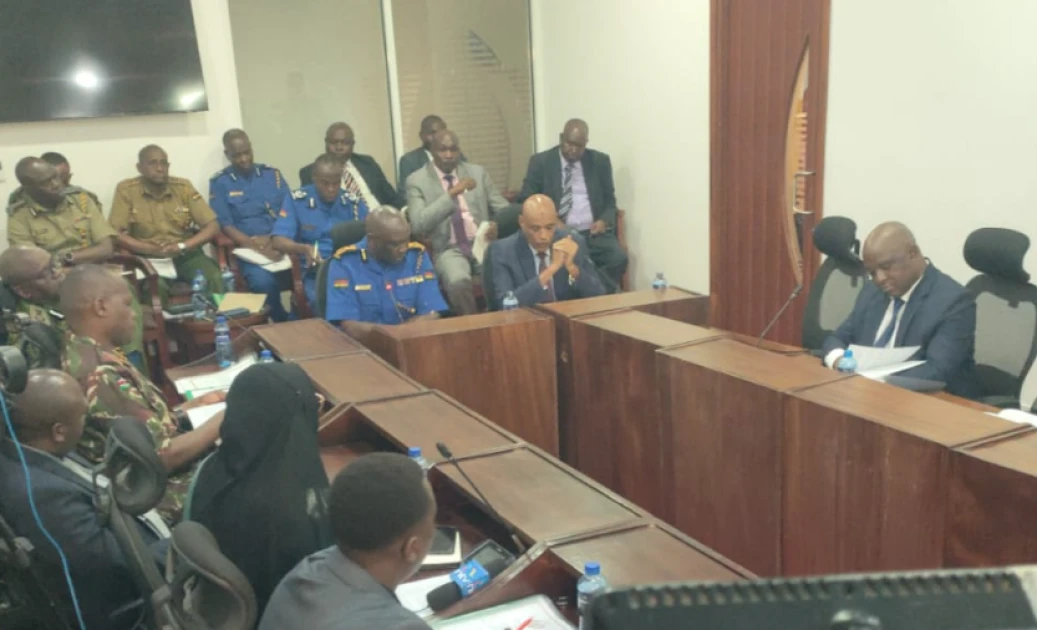
In a tense session on Thursday, Senator Edwin Sifuna pressed Kenya’s top police commanders to account for what he described as troubling delays in investigations into attacks on two of his colleagues.
Appearing before the Senate’s Defence and Security Committee, Inspector General Douglas Kanja and Director of Criminal Investigations Mohamed Amin faced pointed questions over the pace and direction of the probes into incidents involving Senators Fatuma Dullo and Godfrey Osotsi.
Mr Sifuna’s tone was firm. He warned against what he saw as an attempt to shift responsibility onto the victims.
“It would be very unfair for you to try and push this thing back on the victim of such an attack,” he said.
At the centre of the exchange was a basic but critical question: how far have the investigations gone, and what is holding them back?
Mr Sifuna asked whether police equipment such as teargas canisters can be traced through serial numbers and custody records, and whether such items could end up in civilian hands without official involvement.
“Please explain to us whether these items are serialized,” he said. “Is it possible to ascertain where that teargas canister came from?”
He also raised concerns about an earlier directive by the DCI to issue “short course” letters to initial investigating officers. The move, he suggested, required clarification.
“Was this due to incompetence,” he asked, “or does it point to the kind of interference that has been alleged?”
The police leadership did not dismiss the concerns but pointed to procedural steps and ongoing work, though detailed timelines remained unclear during the session.
Questions over delays featured prominently. Mr Sifuna challenged the pace of forensic processes, including ballistic analysis and access to call data records, arguing that prolonged timelines could undermine the cases.
“The timelines being cited do not make sense,” he said, warning that delays risk giving suspects time to evade justice.
He also rejected suggestions that Senator Dullo may have slowed the investigation by being unavailable, noting that public officials are, in most cases, easily reachable.
Beyond the specific cases, the exchange opened a broader debate about the capacity of investigative agencies. Mr Sifuna urged police to state plainly whether resource constraints — financial or technical — were contributing to the delays.
“Parliament needs a clear picture,” he said, “so that we can support any necessary reforms.”
There were also concerns about priorities. Mr Sifuna criticised what he described as the politicisation of policing and the possible misallocation of resources, arguing that the focus should remain on public safety and the resolution of criminal cases.
The session ended without definitive answers on when the investigations would conclude. For now, the questions raised in the chamber linger, not only about two high-profile cases, but about confidence in the institutions tasked with delivering justice.
About the Author