

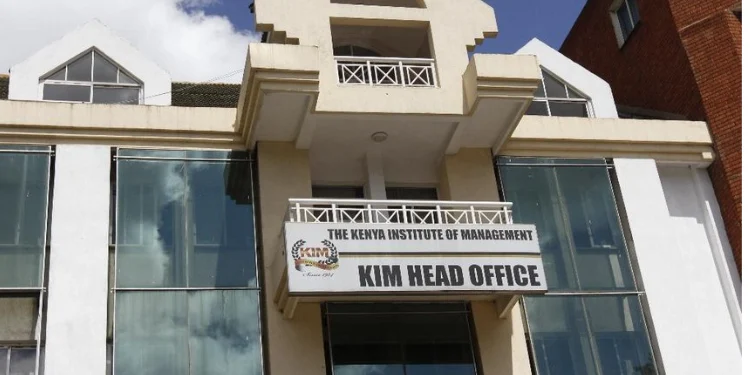
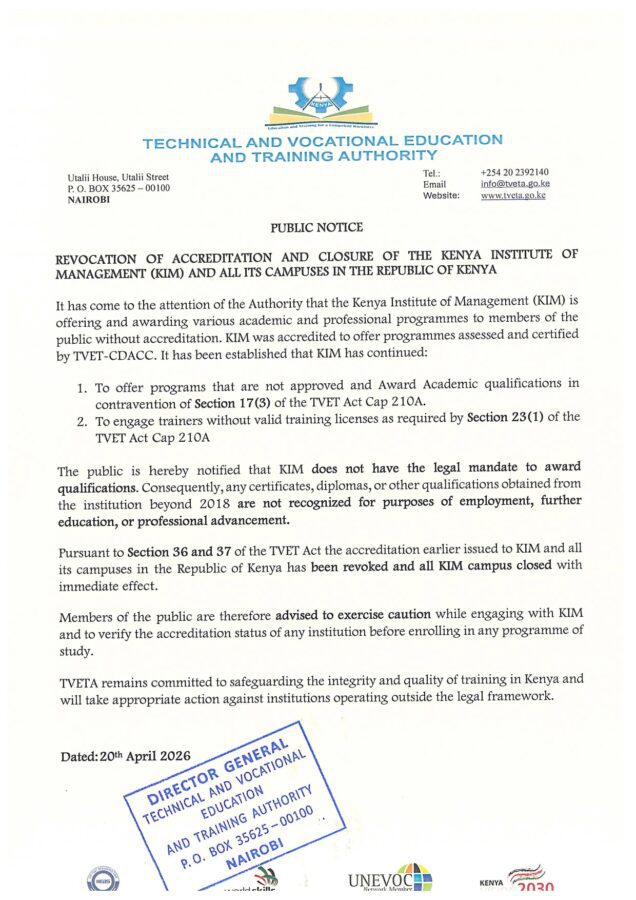
A directive by the Technical and Vocational Education and Training Authority (TVETA) revoking the accreditation of the Kenya Institute of Management (KIM) and ordering the immediate closure of all its campuses has triggered widespread concern, confusion and anger among Kenyans, particularly students and alumni.
In a public notice dated April 20, 2026, TVETA accused KIM of operating outside its legal mandate, including offering unapproved programmes and engaging unlicensed trainers in violation of the TVET Act Cap 210A. The authority further declared that any qualifications issued by the institution after 2018 would not be recognised for employment, further education or professional advancement.
Immediate backlash: “What happens to students?”
The announcement prompted an outpouring of reactions on social media platform X, where users raised urgent questions about the fate of thousands of affected learners.
A recurring concern was the status of students who have studied or are currently enrolled at KIM. “What about those who have paid and studied since 2018?” asked one user, reflecting broader anxiety over sunk costs and uncertain academic futures. Others demanded clarity on whether affected students would be transferred to accredited institutions or compensated.
Several commentators framed the issue as a regulatory failure rather than solely institutional wrongdoing. One user likened the situation to “a passenger boarding a vehicle with expired insurance,” arguing that students should not bear the consequences of oversight lapses by authorities.
Delay in enforcement draws scrutiny
A dominant line of criticism focused on the eight-year gap between the alleged violations and the enforcement action. Multiple users questioned why the regulator had taken so long to act if KIM had been operating outside the law since 2018.
“Why did it take eight years to realise?” asked one post, echoing a broader perception of administrative inertia. Others described the move as evidence of “incompetency,” suggesting that delayed enforcement has compounded the harm to students and employers who relied on the institution’s certifications.
Institutional legacy complicates response
KIM’s long history added another layer to the public reaction. Founded in 1954, the institution has been widely regarded as a key player in management training in Kenya. Some users argued that such an established organisation should not be abruptly shut down without transitional measures.
“How do you wake up and deregister KIM?” one commentator asked, while another noted that the institute predates TVETA itself, raising questions about regulatory continuity and institutional oversight.
Calls for transparency and legal recourse
Beyond student concerns, some Kenyans questioned the legal and procedural basis of the decision. A number of posts called for greater transparency from TVETA, including detailed explanations of the violations and the process leading to the revocation.
Others suggested that such a consequential decision should involve judicial oversight, reflecting unease about the concentration of regulatory authority and due process.
Economic and professional implications
The directive also raises potential ripple effects across Kenya’s labour market. Employers may now face uncertainty regarding the validity of qualifications held by current staff, while affected graduates risk stalled career progression.
Some commentators urged the regulator to adopt a more measured approach, such as fines or corrective directives, rather than an outright closure. “Guide them or penalise them, but don’t shut them down,” one user wrote, pointing to possible job losses and institutional disruption.
Regulator’s position
TVETA, in its notice, maintained that the action is necessary to “safeguard the integrity and quality of training in Kenya.” It advised the public to verify the accreditation status of institutions before enrolling in any programme and warned of further action against non-compliant providers.
Unresolved questions
Despite the directive, several critical issues remain unclear: the fate of current students, mechanisms for credit transfers, liability for unrecognised qualifications, and whether affected parties will seek legal redress.
The coming days are likely to test both the regulator’s capacity to manage the fallout and the broader resilience of Kenya’s technical and vocational education sector.
About the Author