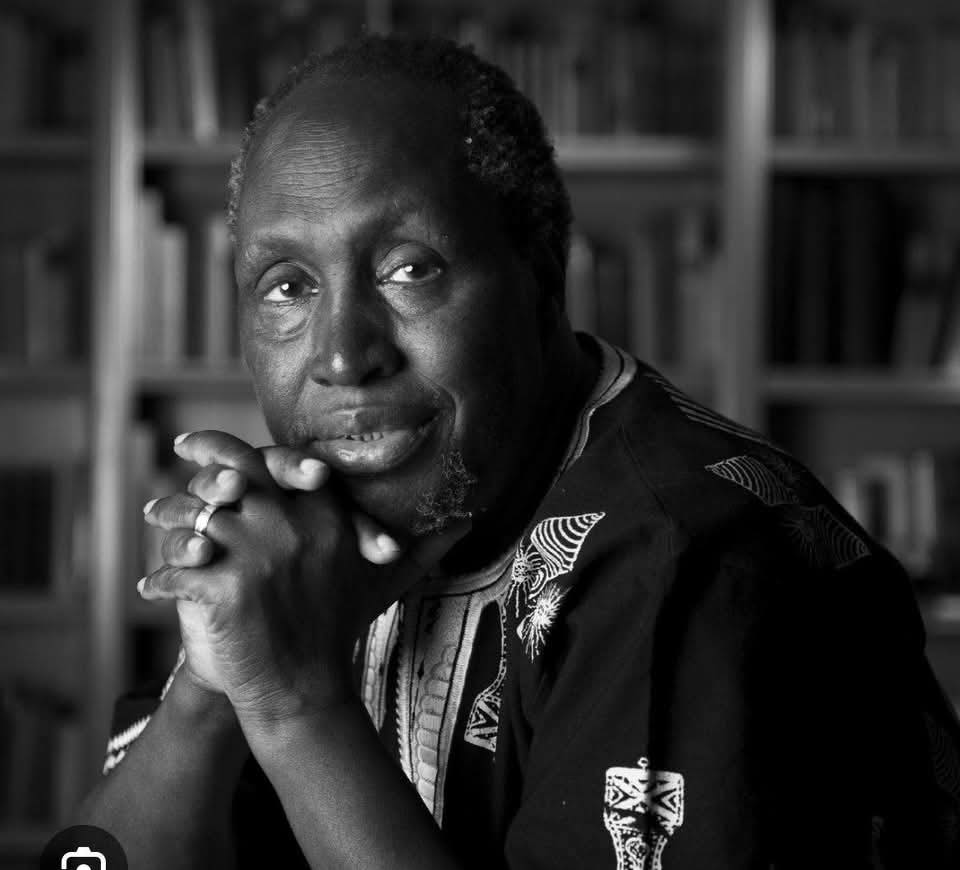
NAIROBI — The family of celebrated Kenyan writer and scholar Ngũgĩ wa Thiong’o has announced that no formal burial will be held for the late literary giant, in accordance with his final wishes.
Instead, a series of commemorative events will be held in Kenya and the United States, where his life and work will be celebrated.
Ngũgĩ, who died in May at the age of 87, requested not to be interred formally. His children and close family members have now confirmed that there will be no public funeral or grave site.
“He wished instead to be remembered in spirit, through the ideals he stood for and the lives he touched,” the family said in a statement released on June 1 and signed by Ndũcũ wa Ngũgĩ, one of his sons.
The first public event will take place in Atlanta, Georgia, on 7 June, from 3 to 5 p.m. at Akazi Gallery. This will be followed by a gathering at the University of Nairobi in June—date to be confirmed—and a formal academic celebration at the University of California, Irvine, on 10 November. A private family ceremony is also planned in Gĩtogothi, Limuru, where Ngũgĩ was born.
Ngũgĩ’s children expressed gratitude for the global outpouring of love and solidarity. “We thank you for the poems, songs, tributes, and support,” they wrote. “Your words remind us of the reach of his message and the depth of his humanity.”
Born in colonial Kenya in 1938, Ngũgĩ rose to become one of Africa’s most influential literary and political voices.
He began his writing career in English but later chose to write exclusively in his native Kikuyu, championing African languages as essential tools of liberation. His novel Devil on the Cross, famously written on toilet paper while he was imprisoned without trial in 1977, remains a cornerstone of post-colonial African literature.
“Language, for him, was both memory and resistance,” said Professor Simon Gikandi, a scholar of African literature at Princeton University. “Ngũgĩ believed that decolonising the mind meant reclaiming African languages and narratives.”
Over his six-decade career, Ngũgĩ wrote more than 30 works spanning fiction, memoir, drama, and critical essays. His 1986 treatise, Decolonising the Mind, remains one of the most cited texts in African studies and post-colonial theory globally.
The family is also encouraging those moved by his legacy to support his foundation, which continues his lifelong advocacy for African languages and translation. Contributions can be made through the Ngũgĩ wa Thiong’o Foundation website.
As tributes continue to flow in from across the world—from writers, academics, students, and heads of state—the man once jailed for his words will now be remembered not with a tombstone, but with a tapestry of voices united by the causes he championed: language, liberation, and the power of storytelling.
In his final act, Ngũgĩ wa Thiong’o chose not to be buried—but to live on in word and spirit.
For details on the upcoming events or to support his foundation, visit www.ngugiwathiongofoundation.org.
About the Author