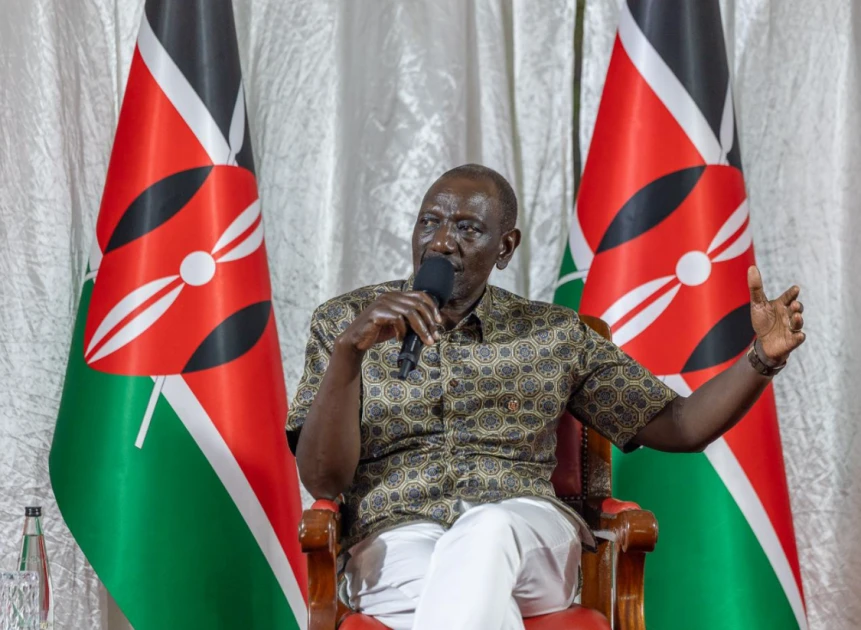
President William Ruto has linked Kenya’s plans for a Sh2 trillion oil refinery in Lamu to lessons drawn from disruptions in the global oil market, particularly during tensions around the Middle East.
Speaking to journalists at State House in Mombasa on Thursday, a day after the refinery’s groundbreaking in Lamu, President Ruto said Kenya had experienced difficulties securing fuel when turmoil affected international supply routes.
He said the disruption prompted him to consider how Kenya could reduce its exposure to similar shocks in future.
“We started experiencing challenges here with fuel when problems arose in the Middle East,” Ruto said, referring to disruption around the Strait of Hormuz.
The President said the government began exploring the idea of building a large refinery rather than repeatedly dealing with fuel shortages caused by events beyond Kenya’s borders.
From an idea to a regional project
Ruto said he sent officials from his office to meet Nigerian businessman Aliko Dangote and visit his refinery in Nigeria.
The officials returned with a recommendation for further research before a decision could be made on where such a facility should be built.
Kenya then held discussions with Uganda and Tanzania as officials examined possible locations for a regional refinery.
Tanga, Tanzania, was initially considered because Uganda had planned to transport its crude oil through Tanzania. But further technical studies changed the direction of the project.
Ruto said Lamu eventually emerged as the preferred site because of its deep-water access.
“The main reason Lamu was chosen is that the sea there has a good draft,” he said, explaining that the depth would allow large oil tankers to access the facility.
Other reporting has also identified Lamu’s deep-water access and its position along the LAPSSET corridor as important factors in the choice of location.
A 700,000-barrel-a-day refinery
The planned Dangote East Africa Petroleum Refinery is designed to process up to 700,000 barrels of crude oil a day.
The project was formally launched in Mokowe, Lamu County, on September 30, with Ruto and Dangote joined by several African leaders. The Kenyan government says the wider complex will include petrochemical and manufacturing facilities, as well as a 1,000-megawatt power plant.
Reuters reported that the $16 billion project is expected to be completed in about 40 months and is intended to reduce East Africa’s reliance on imported petroleum products.
Ruto said Kenya had already secured about 9,000 acres for the development and was seeking another 3,000 acres. A separate Special Economic Zone of about 5,000 acres is also planned.
Jobs and new industries
The government says the refinery could create opportunities beyond oil processing.
Ruto said the project could attract investment and support industries producing plastics, petrochemicals and other petroleum-related products.
The Foreign Affairs Ministry said the wider project is expected to create as many as 60,000 direct and indirect jobs, with training and employment opportunities expected for young people in Lamu, neighbouring counties and elsewhere in Kenya.
For Lamu residents, the proposed industrial complex could bring demand for workers, transport services, construction, accommodation, food businesses, logistics and other support services.
The government has also said the development could strengthen economic activity along the LAPSSET corridor.
Land concerns remain
The project is also facing questions over land rights and the impact of large-scale development on local communities.
While Ruto has said the main refinery site is government land and that no residents will be displaced from it, separate legal challenges have been brought by local residents over land ownership and compensation issues.
A Kenyan court has ordered the parties to maintain the status quo in a land dispute involving residents who have challenged aspects of the project. The case is expected to be heard further in October.
Environmental concerns have also been raised because of the refinery’s location near Lamu’s sensitive coastal and marine environment.
Ruto’s economic expectations
Ruto said the refinery would become a major source of foreign investment and industrial activity.
He estimated that the project could account for about 12 per cent of Kenya’s GDP, while saying foreign direct investment could rise to between $6 billion and $7 billion a year over the coming years.
Those figures are presidential estimates rather than independently established outcomes. Other government and media assessments have similarly highlighted the project’s potential economic contribution, while noting that its full impact will depend on construction, production and investment actually taking place.
The refinery remains a project under construction. Its significance will ultimately depend not only on its size, but also on whether it delivers the promised jobs, local industries, energy-security benefits and opportunities for communities around Lamu.
About the Author