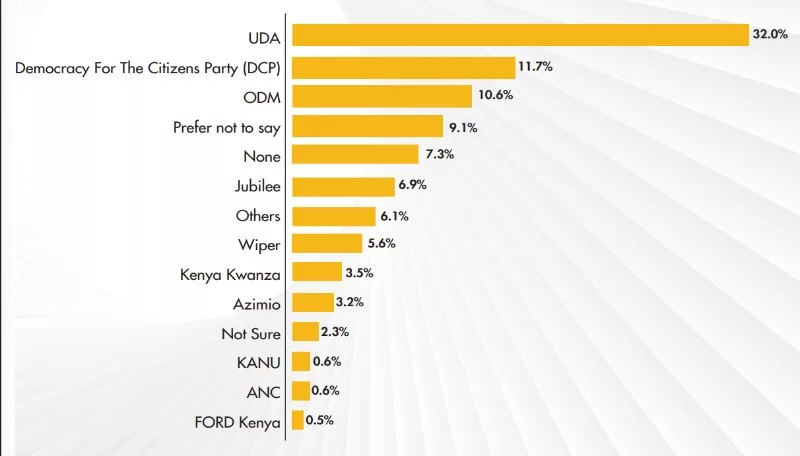
The United Democratic Alliance (UDA) has emerged as the most supported political party in a new Politrack Research Team survey, with 32 per cent of respondents identifying it as their preferred party.
The survey, conducted from September 15 to 25, comes as political parties position themselves for the 2027 General Election and new alliances take shape.
The Democracy for Citizens Party (DCP) followed with 11.7 per cent, narrowly ahead of the Orange Democratic Movement (ODM), which recorded 10.6 per cent.
The 1.1 percentage-point gap between DCP and ODM falls within the poll’s reported margin of error.
DCP Moves Ahead of ODM
DCP’s showing places the party, associated with former Deputy President Rigathi Gachagua, slightly ahead of ODM in the latest survey.
The result comes against a backdrop of changing party loyalties. Earlier polls in 2026 have produced different results, underscoring the fluid nature of political support ahead of the next election.
An Infotrak survey conducted in June, for example, put UDA at 22 per cent, ODM at 21 per cent and DCP at 9 per cent.
A separate TIFA survey released in July placed ODM at 20 per cent, UDA at 17 per cent and DCP at 12 per cent.
Jubilee and Wiper Follow
The Politrack survey placed Jubilee fourth with 6.9 per cent support, followed by Wiper at 5.6 per cent.
The poll also measured support for the broader political formations Kenya Kwanza and Azimio, which recorded 3.5 per cent and 3.2 per cent respectively.
KANU and the Amani National Congress (ANC) each received 0.6 per cent, while FORD-Kenya recorded 0.5 per cent.
Parties that were not individually listed were grouped under “Others”, which accounted for 6.1 per cent.
Nearly One in Five Undeclared
A sizeable share of respondents did not identify with a political party.
Some 9.1 per cent preferred not to disclose their choice, while 7.3 per cent said they supported no party. Another 2.3 per cent were unsure.
Together, those three groups accounted for 18.7 per cent of the respondents.
That figure highlights the number of voters whose party preferences were not settled or publicly declared at the time of the survey.
20,419 Respondents Took Part
Politrack said the survey involved 20,419 respondents from across Kenya.
Participants were invited through a text-based technology platform and could respond at their convenience. The poll reported a 95 per cent confidence level and a margin of error of plus or minus three percentage points.
The findings offer a snapshot of party preferences during the September 15–25 survey period rather than a prediction of the 2027 election result.
With parties continuing to recruit members, negotiate alliances and build their grassroots networks, the distribution of support could change as the election approaches.
About the Author