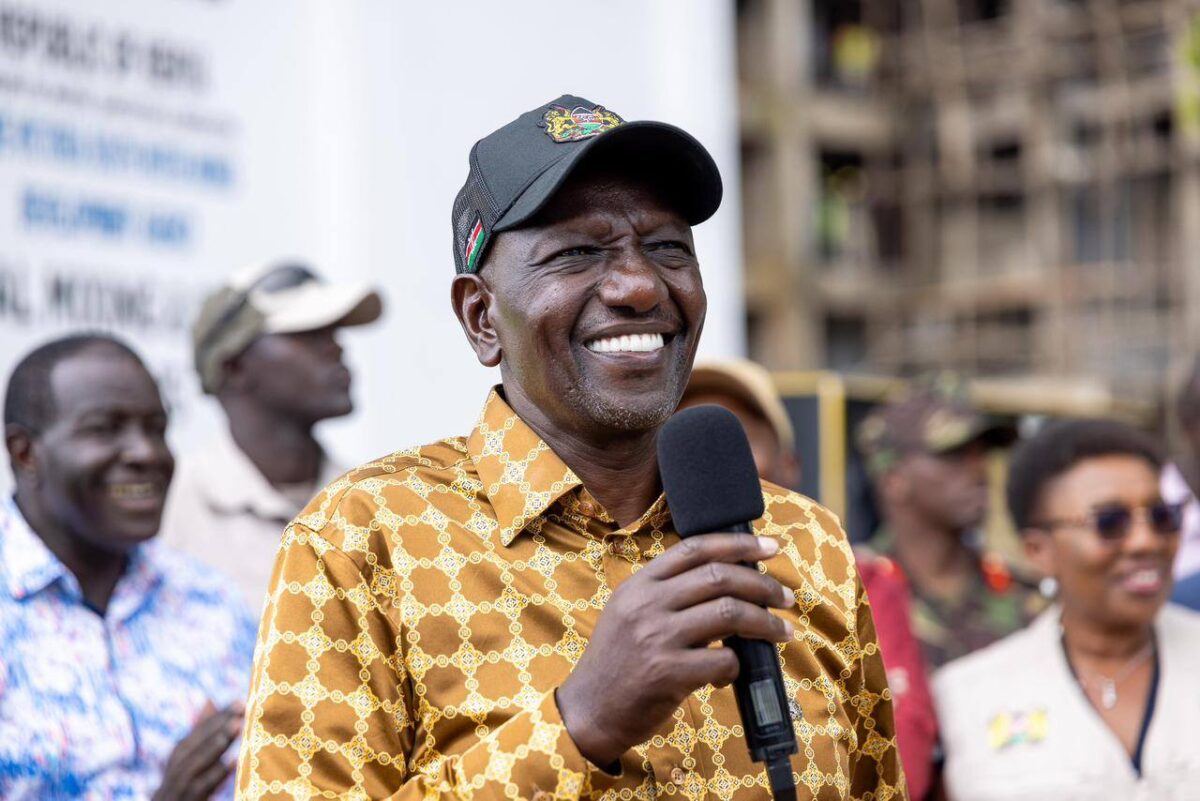
Standard Group’s headline report on President William Ruto’s “unfulfilled promises” struck a sensitive nerve. It portrayed a leader of deep Christian faith as a politician who has failed to deliver on his word — a painful accusation for any leader.
It was bound to sting. But perhaps the President should have allowed it to pass.
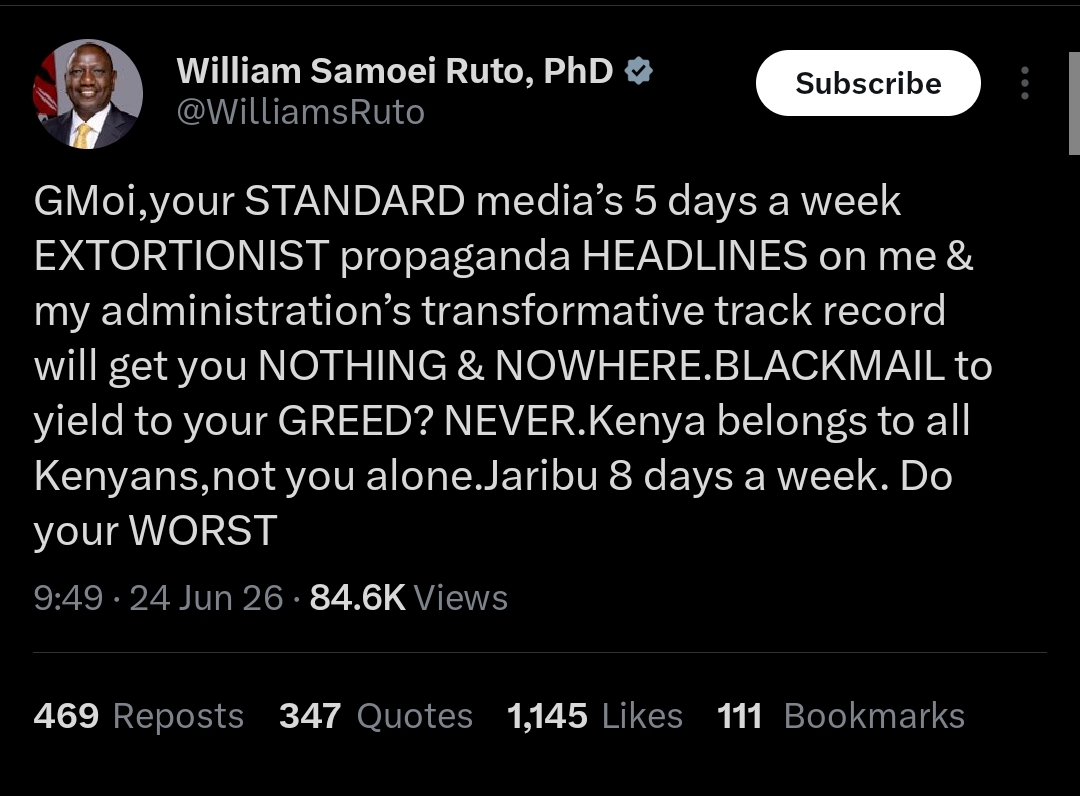
By accusing the newspaper of publishing “extortionist propaganda” against his “transformative track record” in an angry, Trump-style social media response, President Ruto only amplified a story that may otherwise have faded within days. Kenyans have notoriously short political memories, and the controversy could easily have disappeared within 48 hours. Besides, the report was not entirely new; it merely captured a conversation wananchi have quietly been having for years.
The facts remain. The Standard Group is owed billions in advertising revenue by government agencies, the media company did not endorse Ruto during the 2022 presidential election, and Ruto and Gideon Moi, whose family owns The Standard, have had a long-running political rivalry shaped by competing regional interests.
What is also beyond dispute is that there is nothing in law preventing a newspaper from supporting a preferred presidential candidate, provided its journalism remains factual, responsible and credible. Equally, President Ruto is the country’s most powerful public figure. It would be strange for a media house not to scrutinise his decisions, promises and record.
The bigger question, therefore, is not whether The Standard should have published the story. This is why the issue resonates so strongly with many Kenyans.
From his time as Deputy President under Uhuru Kenyatta, through his 2022 presidential campaign and nearly three years in State House, President Ruto has made numerous promises. Some were ambitious; others were arguably unrealistic given the economic challenges facing the country.
The “hustler” message was brilliant political communication. It created hope and a powerful connection with millions of voters. But the same expectations that delivered victory also created the conditions for disappointment once the realities of governing arrived.
When promises fail to materialise, leaders risk being viewed as salesmen who oversold a dream. President Ruto, therefore, should perhaps see criticism not only as an attack but as an opportunity for reflection.
However, fairness demands acknowledging that his government has not achieved nothing. Thousands of kilometres of roads have been constructed, dams, markets, stadia, industrial parks and other infrastructure projects have been rolled out. The administration has also introduced major policy interventions in several sectors, with education reforms — particularly teacher recruitment — standing out as one of its notable achievements.
The question remains: why are many Kenyans not celebrating these accomplishments?
The answer may lie beyond projects and policies.
Voters often judge leaders not only by what they deliver but by how they make them feel. Kenya’s political history offers examples. In 1992, Kanu Secretary General Joseph Kamotho lost badly in Kangema despite his development record, famously complaining that even a dog on a Ford Asili ticket could have won. In 2007, many Kenyans voted against President Mwai Kibaki despite his widely acknowledged economic and infrastructure achievements.
The lesson is uncomfortable: achievements alone do not automatically create affection.
Citizens relate emotionally with leaders. A president who promises a better life but struggles to meet expectations can create disappointment — much like a parent who promises a special meal and arrives home with something completely different.
Development projects matter. Roads, bridges, markets, airports and schools transform lives. But they become politically powerful when people connect them with a leader they trust, respect and feel understands their struggles.
President Ruto’s challenge may therefore not only be about delivery, but also about communication, perception and emotional connection. For a politician known for powerful speeches, he appears to struggle at times to project the image of a leader who listens, reassures, empathises and walks alongside ordinary citizens.
Ultimately, voters want both bread and belonging. They want a leader who provides housing, healthcare, education and opportunities — but they also want one who understands their frustrations, speaks to their hopes and makes them feel seen.
As Bill Clinton’s famous 1992 campaign slogan reminded voters:
“It’s the economy, stupid.”
For President Ruto, perhaps the bigger question is whether Kenyans are feeling the change — not just seeing it.
About the Author
Ted Malanda is an award-winning Kenyan journalist, columnist and editor with over two decades of experience in media. A former Associate Editor at The Standard Group, he is known for his incisive political commentary, wit and storytelling on Kenya’s social and political landscape. He has also worked in strategic communications and conservation advocacy.Ted Malanda is currently a consulting writer and editor based in Nairobi.
Ruto’s Promise Problem: Is He Fighting the Wrong Battle?
Manage Consent
To provide the best experiences, we use technologies like cookies to store and/or access device information. Consenting to these technologies will allow us to process data such as browsing behaviour or unique IDs on this site. Not consenting or withdrawing consent, may adversely affect certain features and functions.
Functional
Always active
The technical storage or access is strictly necessary for the legitimate purpose of enabling the use of a specific service explicitly requested by the subscriber or user, or for the sole purpose of carrying out the transmission of a communication over an electronic communications network.
Preferences
The technical storage or access is necessary for the legitimate purpose of storing preferences that are not requested by the subscriber or user.
Statistics
The technical storage or access that is used exclusively for statistical purposes.The technical storage or access that is used exclusively for anonymous statistical purposes. Without a subpoena, voluntary compliance on the part of your Internet Service Provider, or additional records from a third party, information stored or retrieved for this purpose alone cannot usually be used to identify you.
Marketing
The technical storage or access is required to create user profiles to send advertising, or to track the user on a website or across several websites for similar marketing purposes.