

When President William Ruto addressed the nation on New Year’s Eve, his message was not one of celebration but of reckoning. After two years marked by fiscal strain, public unrest and politically costly reforms, he framed 2026 as the year Kenya must move from stabilisation to delivery.
Speaking from State Lodge in Eldoret, Ruto argued that the most difficult choices of his presidency — subsidy cuts, tax reforms and public finance restructuring — had laid a foundation that now permits acceleration. “For the first time in a long while, Kenya is not guessing,” he said, insisting that the country has shifted from crisis management to long-term planning.
The claim is bold, but the context is unforgiving. Nearly 40 per cent of Kenyans still live below the poverty line, and unemployment — especially among young people — remains stubbornly high. The government’s own figures suggest more than 20 million citizens struggle to meet basic needs, a reality that has fuelled periodic unrest and sharpened scrutiny of the administration’s economic agenda.
From austerity to ambition
Ruto’s address positioned 2025 as a transitional year — one in which painful fiscal adjustments began to show returns. He cited gains in agriculture, including higher maize production, stronger tea earnings and a sharp rise in coffee prices, attributing improvements to fertiliser subsidies and access to certified seed.
Healthcare reforms also featured prominently. More than 29 million Kenyans are now registered under the Social Health Authority, the restructured universal healthcare scheme. The President highlighted cases where costly surgeries and cancer treatment were fully covered, using them to underscore the government’s claim that social spending is becoming more efficient rather than more expansive.
Yet such examples sit alongside uncomfortable macroeconomic truths. Public debt remains elevated, fiscal space is limited, and investor confidence is fragile. The administration’s challenge, analysts say, is not articulating ambition but executing it without reigniting inflation, debt distress or political backlash.
New funds, old risks
Central to Ruto’s plan is the launch, in January 2026, of two major financing vehicles: the National Infrastructure Fund and a Sovereign Wealth Fund. Together, they are meant to reduce reliance on borrowing while mobilising private capital and recycling proceeds from privatised public assets into infrastructure.
If implemented as designed, the funds could improve capital allocation and introduce greater discipline into public investment. However, Kenya’s history of state-led mega projects — often plagued by cost overruns, opaque procurement and weak returns — looms large. The success of the funds will depend less on their design than on governance, transparency and political restraint.
Infrastructure as growth strategy
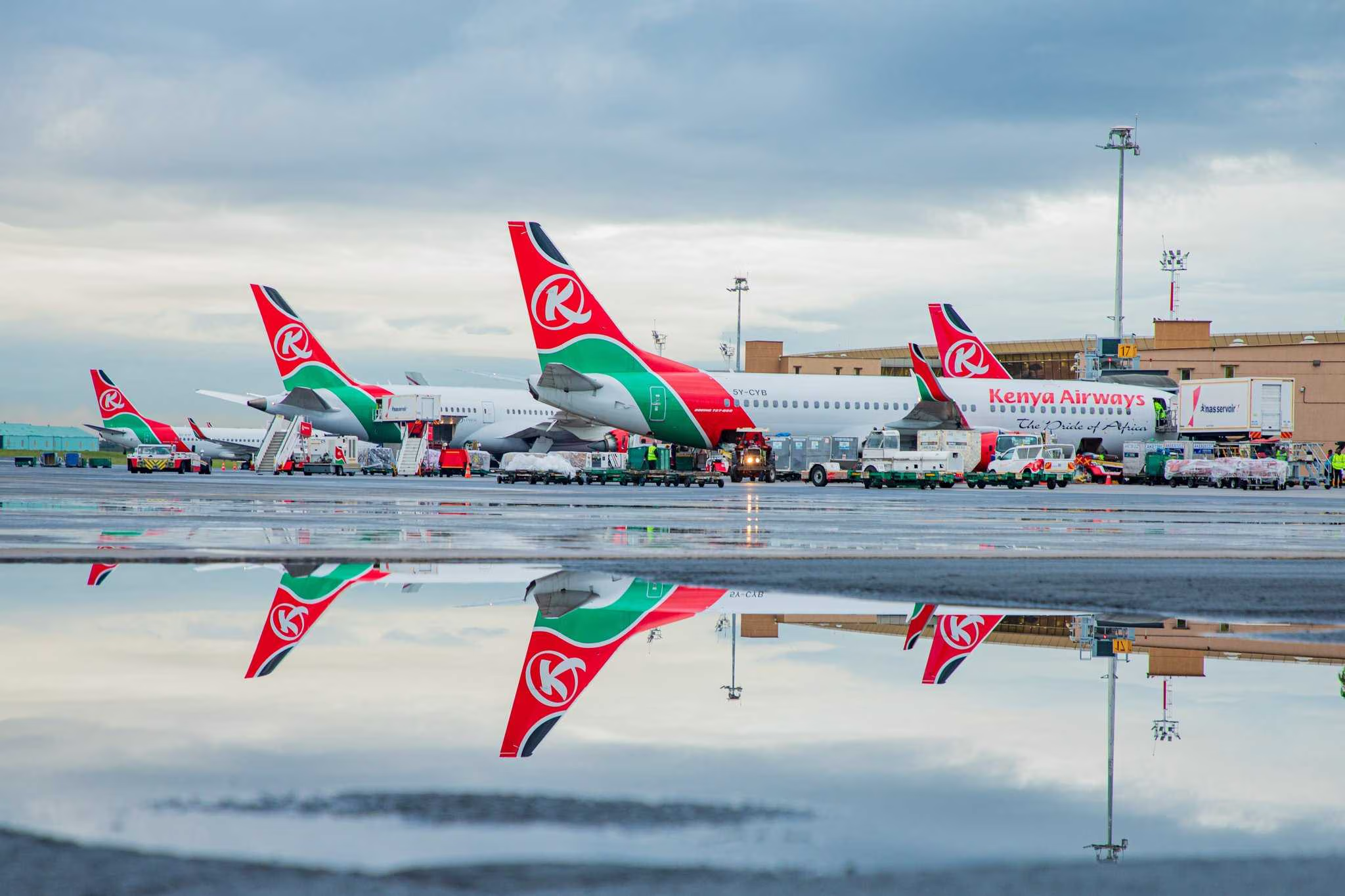
Ruto outlined an expansive infrastructure pipeline, including new highways, a Standard Gauge Railway extension linking Naivasha to Malaba, a major dam at Galana-Kulalu, a new airport at Jomo Kenyatta International Airport, and completion of flagship sports and convention facilities.
The ambition is to anchor Kenya as a logistics, aviation and trade hub for eastern and central Africa. The risk, economists caution, is overextension. Large projects can catalyse growth, but only if aligned with demand, export capacity and fiscal realism.
Order, accountability and dissent
The President also addressed last year’s protests, acknowledging loss of life and property damage while warning against violence and disorder. His remarks reflected a balancing act familiar to reformist governments: defending democratic rights while asserting the authority of the state.
More striking was his framing of alcohol and drug abuse as a national security emergency. With government data indicating that one in six adults uses drugs or substances of abuse, Ruto announced a sharply expanded anti-narcotics unit within the Directorate of Criminal Investigations, alongside asset seizures and tougher enforcement.
Such measures may signal seriousness, but they also raise questions about civil liberties, judicial capacity and institutional integrity — particularly in a system where enforcement agencies themselves have faced corruption allegations.
The real test
Ruto ended his address with a blunt warning to Kenya’s political class: performance will matter more than promises. Leadership, he said, will be judged by outcomes.
For investors, citizens and international partners, that may be the most consequential line of the speech. Kenya’s reform agenda is no longer short of vision. What remains uncertain is whether the state has the institutional strength, political capital and social consent to deliver it — at speed, and at scale.
In that sense, 2026 may indeed be a turning point, but not for the reasons of optimism alone. It is the year when Kenya’s economic strategy will face its most rigorous test yet
About the Author