Artificial intelligence is no longer just writing code, it’s writing songs, and now it’s topping charts.
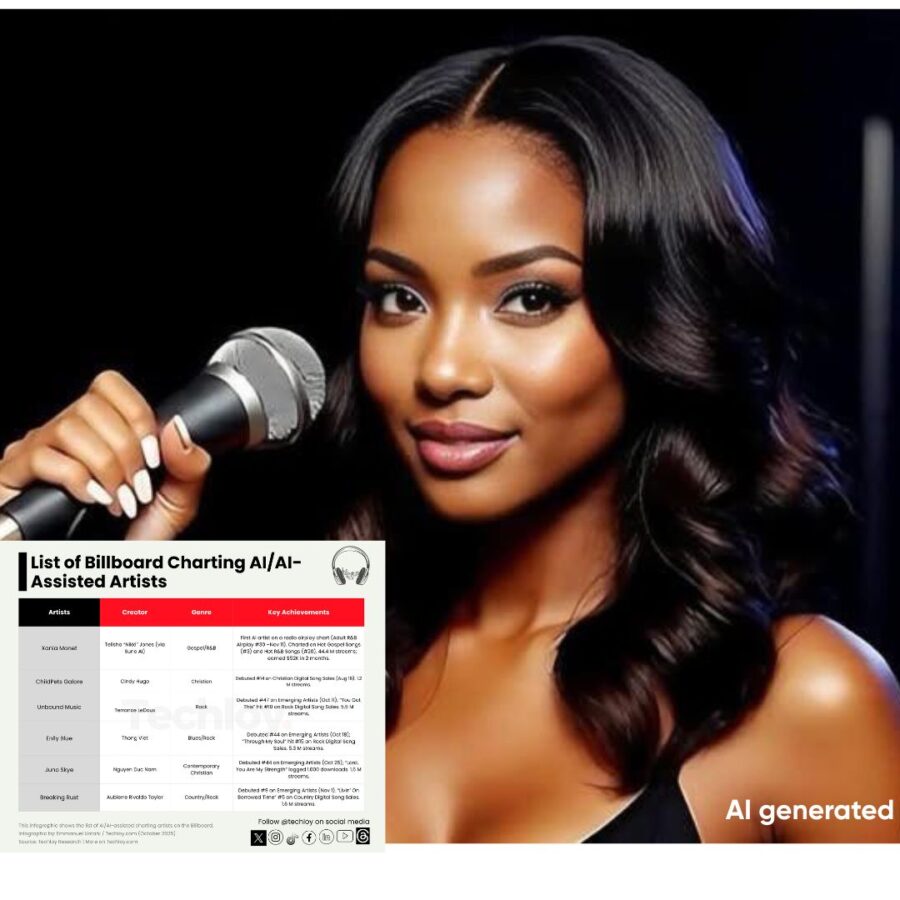
Xania Monet, an AI-powered singer, has made history as the first known virtual artist to earn enough radio airplay to debut on a Billboard radio chart. Her success marks a major moment in the growing relationship between music and artificial intelligence.
Since her first release in mid-2025, Monet’s songs, Let Go, Let God and How Was I Supposed to Know — have appeared on Billboard’s Hot Gospel and Hot R&B Songs charts. Her growing popularity recently led to a multimillion-dollar deal with Hallwood Media after what Billboard described as a “bidding war.”
Created by Mississippi poet Telisha Nikki Jones, Xania Monet’s lyrics are written by Jones and generated through Suno, an AI music creation program. Monet’s style is described as soulful and gospel-inspired, similar to R&B stars like Keyshia Cole and Muni Long.
Her Apple Music profile lists her as a “contemporary R&B vocalist” with a “down-to-earth” tone. She has already released a 24-track debut album, Unfolded, followed by a seven-song EP, Pieces Left Behind, in September.
With more than 146,000 Instagram followers, Monet’s fanbase continues to grow. Supporters praise her sound and message, while others in the industry raise ethical questions about what her rise means for human musicians.
Her manager, Romel Murphy, insists that Monet’s presence is not about replacing real artists. “AI doesn’t replace the artist,” he told CNN. “It’s a new frontier, some people are receptive, others are apprehensive. But music has to evolve.”
Billboard reports that Monet is not alone. In recent months, at least six AI or AI-assisted artists have debuted on various Billboard rankings, spanning genres from gospel to rock.
Still, the rise of AI performers has unsettled some human musicians. R&B artist Kehlani voiced her frustration in a now-deleted TikTok video, saying, “There is an AI R&B artist who just signed a multimillion-dollar deal … and the person is doing none of the work.”
For others, the emergence of AI artists raises questions, not just about creativity, but about authenticity and connection. As the lines blur between human and machine-made music, one thing is clear, the future of music will sound very different.
About the Author