
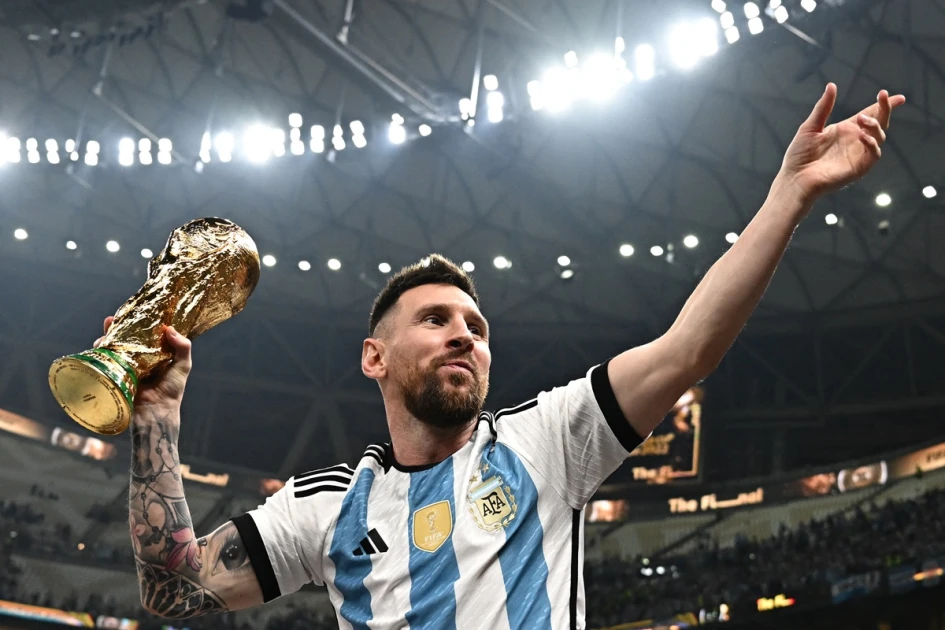
Lionel Messi will walk onto the pitch at Buenos Aires’ Estadio Monumental on Tuesday for what is expected to be his final appearance in an Argentina shirt.
The 39-year-old captain will lead the world champions against Benin in a friendly that has been billed as a farewell to one of the most influential players in the country’s football history.
Around 85,000 supporters are expected at the Monumental for the occasion. The Argentine Football Association has also invited members of the team that won the 2022 World Cup in Qatar to celebrate the moment with Messi and their families.

The match comes after Messi announced his retirement from international football in August. After more than two decades with Argentina, he said he had reached a point where younger players deserved their opportunity.
The decision followed a difficult period for the veteran forward.
Argentina had reached the 2026 World Cup final but lost to Spain in July. Messi was visibly emotional after the defeat, which came at the end of another long campaign with the national team.
A few weeks later, Messi’s father, Jorge Messi, died at the age of 68. The loss added another personal dimension to the uncertainty surrounding the player’s future.
From frustration to national icon
Messi’s relationship with Argentina has not always been as warm as it is today.
For years, his performances for the national team were judged against his extraordinary success at club level. Despite reaching major finals, he was criticised by some Argentine supporters for failing to reproduce his best form with the national side.
His international career also included painful defeats.
Argentina lost the 2014 World Cup final to Germany and suffered defeats in the 2015 and 2016 Copa América finals. After the 2016 Copa América Centenario final, Messi briefly announced his international retirement.
He eventually returned and continued to pursue the major international title that had eluded him.
That persistence eventually changed his standing in Argentina.
Messi led the team to Copa América glory in 2021, ending a 28-year wait for a major senior men’s international trophy. He then helped Argentina win the 2022 World Cup in Qatar, defeating France on penalties in a dramatic final.
Argentina added another Copa América title in 2024, further cementing Messi’s place in the country’s football history.
A record-breaking international career
Messi leaves Argentina as the country’s most-capped player and leading goalscorer.
He has scored 125 goals in 207 appearances for the national team and is expected to make his 208th and final appearance against Benin.
His international honours include:
- 2022 FIFA World Cup
- 2021 Copa América
- 2024 Copa América
- Finalissima 2022
His achievements have placed him among the most decorated players in international football.
Yet the numbers only tell part of the story.
For Argentina, Messi’s greatest legacy may be the way he eventually transformed the relationship between the national team and its supporters. Reuters described his journey as a long and difficult path from scepticism to widespread admiration.

A farewell with old teammates
The Monumental farewell will bring together players from different stages of Messi’s Argentina career.
Members of the 2022 World Cup-winning squad have been invited to attend, including players who shared the historic triumph in Qatar.
Among those expected to form part of Argentina’s next chapter are Cristian Romero, Alexis Mac Allister, Enzo Fernández, Julián Álvarez and Lautaro Martínez.
Romero is among those expected to become one of the team’s leading figures after Messi’s departure.
The transition has already begun.
Argentina played Bolivia in Córdoba on September 30 before beating Burkina Faso 7-0 at the Monumental on October 3. The results offered an early glimpse of a team learning to operate without its long-time captain.
Coach Lionel Scaloni, who guided Argentina to its recent run of success, has acknowledged the emotional weight of Messi’s departure.
He has also recognised the challenge facing the team as it moves into a new era.
Messi’s presence has shaped Argentina’s football for more than 20 years. Replacing his influence, even collectively, will not be straightforward.
The future of the No. 10 shirt
One of the most symbolic questions surrounding Messi’s departure is what happens to Argentina’s famous No. 10 shirt.
Messi has worn the number for much of his international career, following in the footsteps of another Argentine football icon, Diego Maradona.
Argentina has deliberately left the number unused during recent matches, but the shirt cannot simply be retired permanently in major FIFA competitions because of squad-number rules.
For now, the number remains closely associated with Messi.
That makes Tuesday’s match even more significant.
He will wear the No. 10 for the final time as Argentina’s captain, surrounded by supporters who have watched his entire journey, from the criticism of his early years to the celebrations that followed his World Cup triumph.
More than just a friendly
Benin’s role in the occasion is also significant.
The West African side arrives in Buenos Aires as the opponent for a match that will be dominated by attention on Messi. But Benin coach Gernot Rohr has stressed that his team intends to compete rather than simply serve as part of the celebrations.
For Argentina, however, the result will almost certainly be secondary to the farewell.
The match represents the closing chapter of Messi’s international career and the beginning of a new one for Argentina.
The country that once questioned whether Messi could deliver on the international stage now prepares to say goodbye to the player who finally brought home the World Cup.
At the Monumental on Tuesday, the applause will be for more than a footballer.
It will be for two decades of goals, defeats, comebacks, trophies and, ultimately, a World Cup triumph that completed Messi’s long journey with Argentina.
About the Author