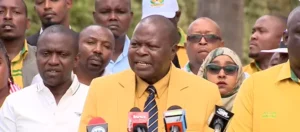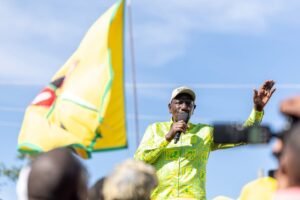
Former Cabinet Secretary Moses Kuria is alleging that political operatives worked to secure Former president Uhuru Kenyatta’s victories in the 2013 and 2017 presidential elections, reviving questions about two of Kenya’s most disputed polls.
Speaking on Inooro FM, Kuria said he was personally involved in efforts to prevent the 2013 election from going to a second round.
Uhuru knows better what we did for him in 2013 and 2017. He knows the strategy we applied,” Kuria said.
His remarks come days after former President Kenyatta said he believed the late Raila Odinga had won the 2022 presidential election.
Kuria Revisits 2013 Vote Dispute
The centre of Kuria’s account is a legal dispute over rejected presidential ballots.
In 2013, Kenyatta was declared the winner with 6,173,433 votes, or 50.07 per cent. Odinga received 5,340,546 votes, according to the Supreme Court record.
Kuria, Denis Itumbi and Florence Jematiah Sergon had filed a petition challenging the inclusion of rejected votes in the calculation used to determine whether a candidate had crossed the constitutional threshold.
Kuria now says the case was part of a wider effort to keep Kenyatta from facing Odinga in a runoff.
“I saved him from the runoff,” he said, adding that lawyers Fred Ngatia and Njoroge Regeru represented them in the case.
The Supreme Court ultimately ruled on the treatment of rejected votes and upheld Kenyatta’s election. The court record confirms that the petition filed by Kuria and his co-petitioners challenged the inclusion of rejected ballots in the calculation.
That ruling is an established part of the electoral record. Kuria’s claim that the court action was deliberately used as part of a rigging scheme is his own account.
Kuria Alleges IEBC Servers Were Tampered With
Kuria went further, alleging that the campaign to secure Kenyatta’s 2013 victory also involved interference with IEBC technology.
“We even did something in the servers to save him; we did it with Davis Chirchir to save him from facing Baba in a runoff,” he said.
Kuria did not provide publicly verifiable evidence in the interview to substantiate the allegation.
The claim also differs from the established court record. The Supreme Court documented problems with the electronic transmission system during the 2013 election and noted that the IEBC eventually relied on manual tallying. But the court’s judgment does not establish that political operatives altered the results through the servers.
The allegation is therefore best understood as a claim by Kuria, rather than a finding by a court or electoral authority.
2017 Election Was Also Disputed
Kuria also referred to the 2017 election, saying he and others had used a similar strategy.
That election produced a separate legal history.
The IEBC declared Kenyatta the winner of the August 8, 2017 presidential election. Odinga challenged the result at the Supreme Court, which later annulled the election and ordered a fresh vote.
The Supreme Court’s decision was based on violations of the Constitution and electoral law. It did not find that Kuria had personally rigged the election.
A fresh presidential election was held on October 26, 2017, after the court’s order.
The IEBC has previously rejected claims that its electoral systems were compromised. In its response to allegations surrounding the 2017 election, the commission said its results transmission server was accessible to authorised party agents and disputed claims that the system had been manipulated.
Claims Put Kenya’s Election History Back in Focus
Kuria’s latest remarks are likely to renew debate over the conduct of Kenya’s past elections, particularly because they come from a politician who was directly involved in the 2013 legal challenge.
But his account raises questions that cannot be settled by political statements alone.
The court record confirms the rejected-vote petition. It confirms the difficulties that affected electronic transmission in 2013. And it records the subsequent legal challenges to the presidential results.
It does not, however, establish Kuria’s allegation that he and others manipulated IEBC servers.
Kuria’s claims about the two elections therefore remain allegations requiring independent evidence. Neither the existence of the court case nor the Supreme Court’s later decisions, by themselves, prove the wider scheme he has described.
About the Author