
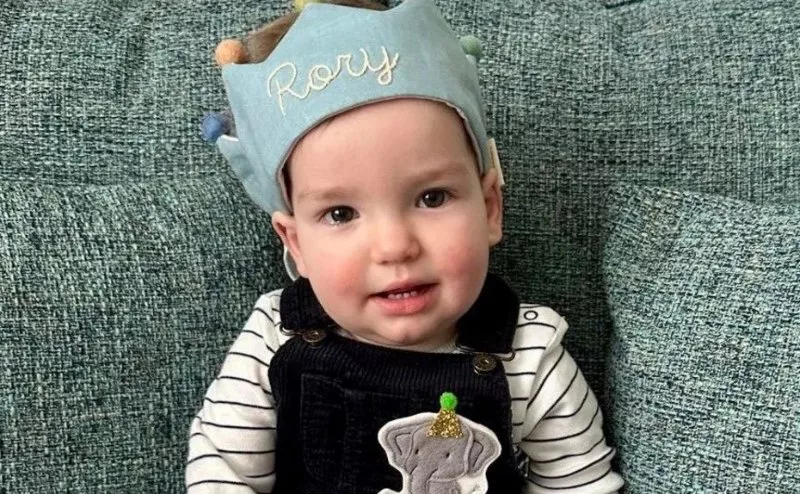
A one-year-old boy in Britain is doing well after becoming the first patient in the world to receive a new type of surgery designed to reshape the skull.
Rory Potter, from Chesterfield in Derbyshire, was born with severe sagittal craniosynostosis, a rare condition in which parts of a baby’s skull fuse too early. He was diagnosed soon after his birth in April last year.
Doctors at Great Ormond Street Hospital in London later chose Rory for an experimental approach using specially designed springs made from nitinol, an alloy of nickel and titanium.
The springs were inserted during surgery in September. They gradually changed the shape of his skull before being removed several weeks or months later.
His mother, Jo Potter, said the change had been remarkable.
“You wouldn’t know what he’s been through,” she said, describing her son as “happy, cheeky and full of energy”.
She said Rory was reaching his developmental milestones like other children his age.
A rare condition diagnosed in infancy
Craniosynostosis occurs when one or more of the joints between the bones of a baby’s skull close earlier than they should.
In severe cases, this can affect the shape of the head and restrict the space available for the growing brain.
Rory’s condition was considered severe enough for specialists at Great Ormond Street Hospital to consider an alternative to the traditional treatment.
For about two decades, surgeons have used stainless-steel springs during some skull reconstruction procedures. The springs help gradually widen the skull, allowing new bone to form as the child’s head grows.
The new treatment uses nitinol springs, which can change shape and exert a more controlled force as the skull develops.
Springs designed for each child
The springs are individually designed for the patient and remain in place for a period of weeks or months.
The aim is to reshape the skull gradually rather than relying solely on a longer, more invasive operation.
Professor Owase Jeelani, a consultant neurosurgeon at Great Ormond Street Hospital who led Rory’s operation, said the new springs could give surgeons greater control.
“These new nitinol springs give us much greater flexibility and, in some cases, can prevent the need for further surgery,” he said.
He described Rory’s operation as an important step in the treatment of children with craniosynostosis, while noting that the team had so far seen encouraging results.
Years of research behind the operation
The technology was developed by specialists at Great Ormond Street Hospital and University College London.
Professor Silvia Schievano, who led the biomedical engineering team at UCL, said the project had taken years of research before the technology could be used in a child.
She said seeing the treatment produce a positive result demonstrated the value of bringing engineering research and clinical medicine together.
The research was funded by Great Ormond Street Hospital Charity and the National Institute for Health and Care Research’s Great Ormond Street Hospital Biomedical Research Centre.
For Rory’s parents, however, the scientific milestone is secondary to seeing their son grow up healthy.
Jo Potter said she and her husband, Harry, were grateful to the medical team for its care and support.
She added that Rory would have “a great story to tell when he’s older“.
About the Author