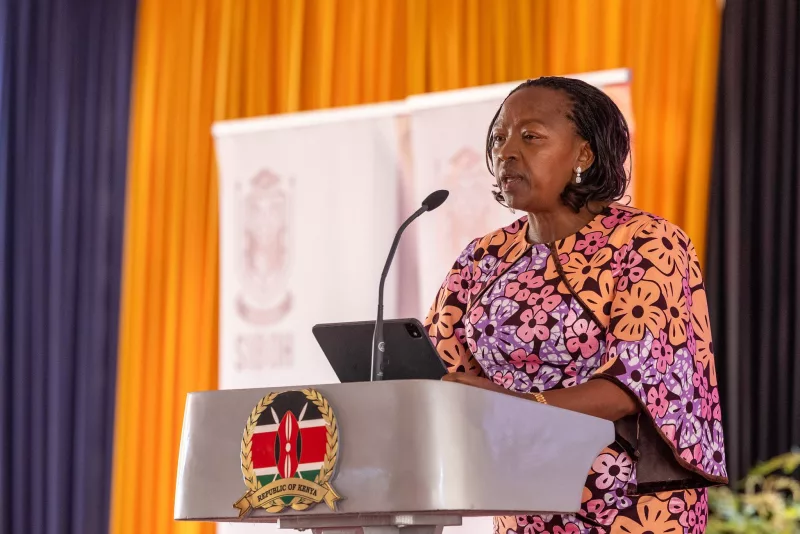
First Lady Rachel Ruto has called for faster action to prevent maternal and newborn deaths in Kenya, saying the country has many of the tools needed to save lives but must do more to put them into practice.
Speaking at the Kenya Health Summit in Nairobi on Wednesday, she said reducing preventable deaths would require sustained investment, enough health workers, reliable supplies and referral systems that work when emergencies arise.
“No mother, no child should be lost to something preventable,” Rachel said. “We must ask ourselves, how do we turn the promise to a reality?”
Kenya has made progress in some areas of maternal and child health, but deaths remain a serious concern. Government health data based on the 2019 census puts maternal mortality at 355 deaths per 100,000 live births. The 2022 Kenya Demographic and Health Survey puts neonatal mortality at 21 deaths per 1,000 live births.
The figures have also highlighted the gap between national health commitments and what happens in facilities, particularly in areas where staffing, equipment and access to specialist care remain limited.
Turning commitments into results
Rachel said the response should involve the government, health workers, development partners and other stakeholders.
“The answer is not complicated,” she said, pointing to leadership, investment, skilled health workers, reliable equipment and supplies, functioning referral systems and accountability.
Her remarks come as the government steps up efforts under its maternal and newborn health agenda. In May, the Ministry of Health launched the Every Woman Every Newborn Everywhere acceleration plan, alongside a six-month initiative aimed at speeding up action in counties with a high burden of maternal and newborn deaths.
The plan includes an additional KSh4 billion through the Social Health Authority for maternal healthcare, KSh1 billion for essential maternal and newborn commodities and KSh2.5 billion for family planning supplies. The government has also announced plans to recruit and deploy 5,000 nurses and midwives.
Rachel said those commitments would matter only if they translated into better care for women and newborns.
The cost of delays
She placed particular emphasis on referral systems, where delays in moving a critically ill mother or newborn can have serious consequences.
She also called for health workers to have the equipment and supplies needed to respond to emergencies.
“Let us build a Kenya where a mother does not have to be wealthy to receive quality care,” she said, “where a newborn’s survival is not determined by the county in which they are born.”
The Ministry of Health has previously identified delays in accessing and receiving care as a key challenge in maternal and newborn health and has backed efforts to strengthen emergency referral services.
Rachel also stressed that maternal and newborn deaths should not be reduced to statistics.
“Those are not just numbers,” she said. “Behind every single one is a mother, a newborn and a family that carries the loss forever.”
A test for Kenya’s health reforms
The government has been pursuing wider Universal Health Coverage reforms, including changes to health financing and maternal care under the Social Health Authority.
President William Ruto has said the reforms are intended to reduce the financial barriers that prevent women from accessing safe maternity services.
But the challenge extends beyond financing. Kenya’s own health strategy shows that access to antenatal care, staffing, equipment and quality services remains uneven.
For Rachel, the next test is whether existing commitments can produce measurable improvements.
“As a goodwill ambassador for newborn screening in Kenya, I am encouraged by what the Ministry of Health has already committed to,” she said.
Her message at the summit was ultimately a simple one: Kenya has made the promises. The priority now is to make sure they save lives.
About the Author