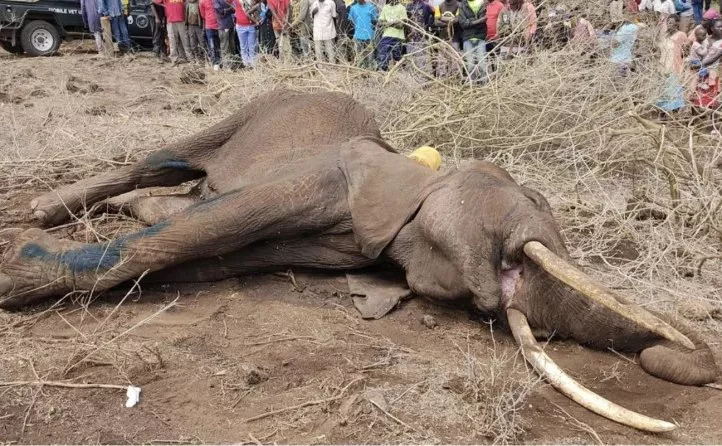
Four people have been arrested as investigators try to determine what killed 18 elephants in Kenya’s Amboseli ecosystem, a case that has raised fresh concerns about the safety of wildlife living alongside farms and communities.
Tourism and Wildlife Cabinet Secretary Rebecca Miano said on Saturday that the four were being treated as persons of interest. Investigators are also searching for a fifth person who they believe may have information relevant to the case.
The deaths were recorded across the Amboseli ecosystem, with the first 15 reported between June 24 and July 24. Three further deaths have since brought the reported total to 18.
The investigation has brought together the Kenya Wildlife Service, security agencies, investigators and scientific institutions. Authorities have carried out field examinations, laboratory tests and environmental sampling as they work to establish what happened.
Miano said preliminary laboratory findings pointed to the possible involvement of a toxic substance.
Earlier findings had raised the possibility of cyanide poisoning after elephants were believed to have eaten tomatoes contaminated with pesticides on farms bordering wildlife areas. But officials have stressed that this remains an early finding and has not yet been confirmed.
The investigation took a new turn after officers searched an area in Tikondo, Kimana, in Loitoktok Sub-County. They recovered several substances, including unlabelled chemicals believed to have come from a neighbouring country.
The materials have been secured for scientific testing. Investigators are expected to determine their composition and whether they have any connection to the elephant deaths.
But the poisoning theory remains disputed by some people living in the Amboseli area.
Reporting by EFE found that local farmers and community representatives questioned whether contaminated tomatoes were responsible. Some said people and livestock in the area regularly consume the produce without apparent harm. Community representatives have also suggested that an unidentified disease could be responsible for the deaths.
Kenya Wildlife Service officials, however, have said their conclusions are being guided by laboratory evidence and that the investigation remains open. The conflicting accounts underline why authorities are waiting for further scientific analysis before reaching a final conclusion.
Miano has also cautioned against treating the arrests as proof of guilt.
“The arrest of persons of interest and the recovery of exhibits do not in themselves establish criminal culpability,” she said.
That distinction is important as investigators build the case. The recovered substances will need to be analysed, while any link between them and the deaths will have to be established through evidence.
The Government has described the incident as a wider conservation and security concern. It says it plans to strengthen surveillance, intelligence sharing, scientific investigations and rapid response in areas where wildlife and human activity overlap.
Officials also want closer monitoring of hazardous substances, including their illegal use, trafficking and careless handling.
The Amboseli case has placed renewed attention on the relationship between wildlife and communities living around protected areas. Elephants do not remain within park boundaries. They move through community land, farms and other landscapes in search of food and water.
Miano praised residents around Amboseli for sharing information with investigators and assisting the operation.
She said communities were essential partners in protecting Kenya’s wildlife.
For now, the central question remains unanswered: what caused the elephants to die?
Investigators are continuing to pursue leads, while laboratory testing is expected to determine whether poisoning was involved. If sufficient evidence establishes criminal responsibility, the Government says those responsible will face prosecution.
About the Author