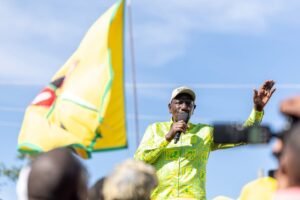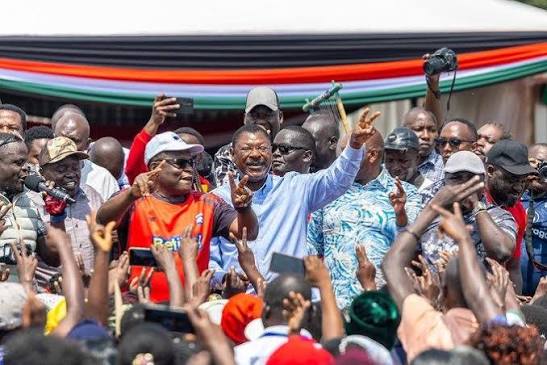
Speaker of the National Assembly Moses Wetang’ula and President William Ruto’s close aide Farouk Kibet are leading a major Kenya Kwanza political rally in Eldoret on Friday, signalling the coalition’s renewed push to consolidate support ahead of the 2027 General Election.
The gathering, held at Silverline Grounds in Eldoret’s central business district, has drawn more than 30 Kenya Kwanza leaders from the Rift Valley and Western regions. Organisers temporarily closed part of Ronald Ngala Street to accommodate the event, with supporters arriving from early morning.
Hosted by Uasin Gishu Governor Jonathan Bii, the rally is centred on voter registration, the government’s development record, and calls for unity as the coalition begins laying the groundwork for President Ruto’s re-election campaign.
Among those expected to attend are National Assembly Majority Leader Kimani Ichung’wah, Senate Majority Leader Aaron Cheruiyot, MPs Sylvanus Osoro, Mwengi Mutuse, Oscar Sudi, Innocent Mugabe, John Bwire, Didmus Barasa and Japheth Nyakundi.
“Our main agenda will be the unity of our people, peace and focus on development as we head to the elections,” Farouk Kibet said ahead of the rally.
Farouk has become an increasingly influential figure in Kenya Kwanza’s mobilisation efforts across the Rift Valley and Western regions. His political profile has also grown in Turbo Constituency, where residents have urged him to contest the parliamentary seat next year.
Although he has not formally declared his candidature, his slogan, “Turbo Kwanza, Mambo baadaye,” has gained traction locally as he continues to support community development initiatives.
The rally comes as President Ruto has repeatedly expressed concern over low voter registration in parts of the Rift Valley, traditionally regarded as one of his strongest political bases. Local leaders have since stepped up campaigns encouraging eligible residents to register ahead of the next election.
Friday’s event marks one of the coalition’s largest political gatherings in Eldoret in recent months. Until now, Kenya Kwanza leaders have largely relied on church visits, empowerment programmes and smaller public engagements to maintain their presence in the region.
The rally also reflects an early shift towards more visible political mobilisation as parties begin positioning themselves well ahead of the official campaign period.
About the Author