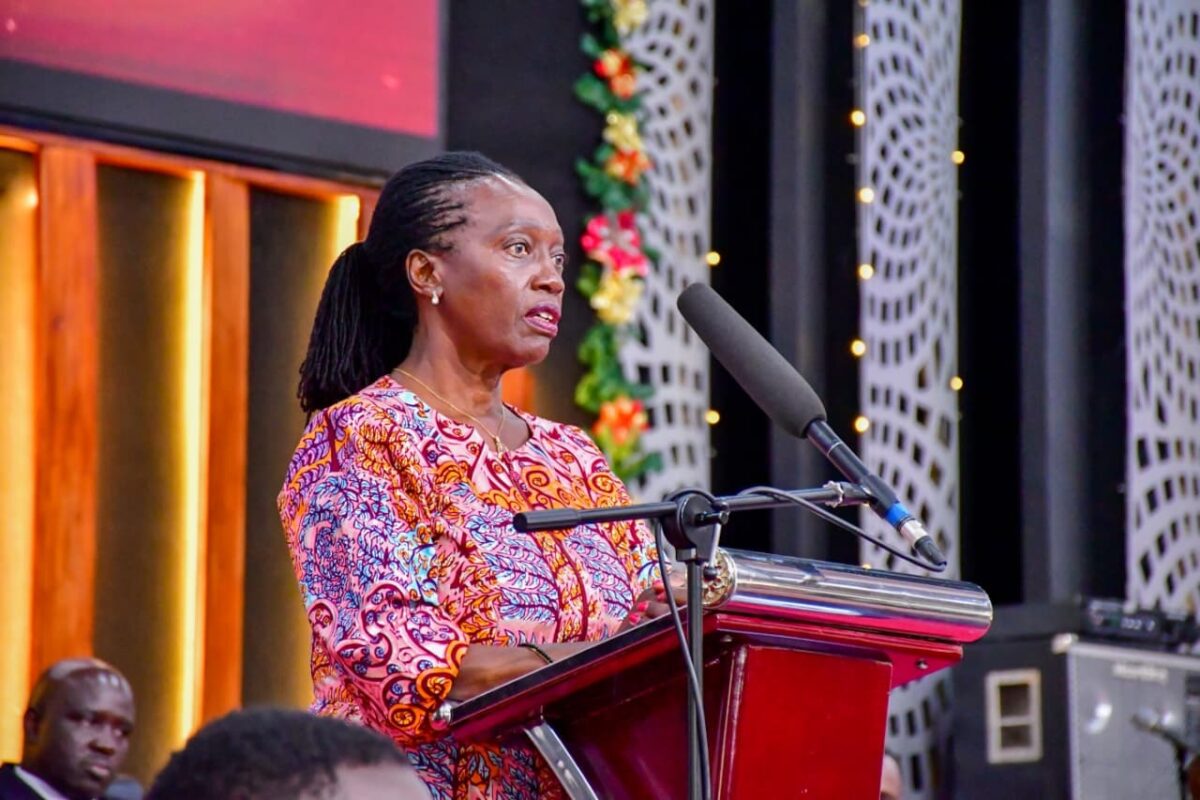
Martha Karua has drawn a clear line ahead of Kenya’s 2027 General Election: she will either seek the presidency as the opposition’s joint candidate or support whoever is chosen to carry the coalition’s banner, but she will not serve as a deputy.
Speaking during an interview on Citizen TV’s Sunday Live program, the leader of the People’s Liberation Party (PLP) said her ambitions remained focused on becoming the opposition’s presidential nominee. At the same time, she pledged support for a consensus candidate if the coalition ultimately settles on another contender.
“I will not be a running mate,” Karua said. “I will do my best to be that united opposition candidate, but should somebody else be chosen, I am willing to support them without being their running mate.”
Her remarks come as opposition leaders continue discussions on how to build a united challenge to President William Ruto in the next election, now just over a year away.
While coalition talks continue, Martha Karua said her party has already shifted into campaign mode. She pointed to what the party calls the “Purple Train”, an initiative aimed at recruiting members, strengthening grassroots structures and identifying candidates for elective positions across the country.
“The party is on its own to widen its membership and its candidate base,” she said. “Although we belong to the United Opposition, we have taken time to market the People’s Liberation Party, increase membership of the liberation movement and ensure that we have enough candidates.”
Her comments highlight a balancing act facing Kenya’s opposition parties. While leaders publicly embrace unity, individual parties are also working to expand their political reach and consolidate support ahead of what is expected to be a fiercely contested election.
Martha Karua argued that opposition leaders should formalize their relationship through a written agreement governing how a presidential candidate is selected and how coalition members conduct themselves during the process.
“I long for the day that we will have a written document as the opposition rules of the game,” she said, adding that all parties should commit themselves to supporting whoever emerges as the chosen candidate.
Such an agreement, she suggested, would help prevent disputes and strengthen confidence among coalition partners. However, she acknowledged that no such framework has yet been finalised.
“We must sign that document sooner or later, but as we stand, we do not have that document,” she said.
Beyond selecting a flag bearer Karua said the opposition should also agree on a shared policy platform. A joint manifesto, she argued, would give coalition members a common programme and reassure supporters that the alliance stands for more than electoral arithmetic.
“We also need a joint manifesto,” she said. “These are the irreducibles so that everybody feels they fit in.”
The question of who will eventually lead the opposition into the 2027 contest remains unresolved. Several prominent figures are widely viewed as potential candidates, and discussions over the selection process have intensified in recent weeks.
Asked whether other opposition leaders had committed themselves to backing a successful nominee, Karua declined to speak on their behalf.
“That’s a question each one of them has to answer,” she said. “Nobody can answer for the other.”
Kenya’s opposition appears united in its desire to challenge President Ruto’s administration. Whether that unity can be translated into a common candidate and a shared political program may prove one of the defining questions of the country’s next election campaign.
About the Author