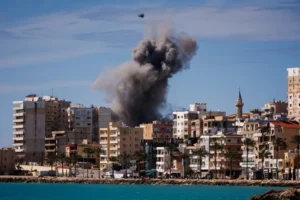


Hamas on Thursday accused the United States of being complicit in Israel’s unprecedented strike in Qatar that killed six people, including five Palestinians and a Qatari soldier. The group said the attack was an attempt to sabotage fragile ceasefire talks over Gaza.
“This crime was an assassination of the entire negotiation process,” Hamas spokesman Fawzi Barhoum said in a televised address. He added that Washington was “a full accomplice.”
The strike on Tuesday stunned the region. Qatar, a Gulf state often shielded from direct conflict, had hosted multiple rounds of indirect talks between Hamas and Israel. Now, its role as mediator is in question.
At the funeral in Doha, Qatar’s emir, Sheikh Tamim bin Hamad Al Thani, joined mourners at the Sheikh Mohammed bin Abdul Wahhab Mosque. One coffin was draped with a Qatari flag, five others with Palestinian flags. Security was heavy, with checkpoints along the main roads. The dead were later buried at Mesaimeer Cemetery.
Qatar confirmed that Lance Corporal Badr Saad Mohammed al-Humaidi al-Dosari, a member of its security forces, was among those killed. Hamas said its casualties included Hamam al-Hayya, son of senior negotiator Khalil al-Hayya, as well as his office director and three bodyguards.
The fate of Khalil al-Hayya himself remains unclear. His wife, daughter-in-law and grandchildren were reported injured, but he did not appear at the funeral.
Qatari Prime Minister Sheikh Mohammed bin Abdulrahman Al Thani, speaking to CNN, said he could not confirm whether Hayya had survived. He warned the attack had “killed any hope” of progress on the release of Israeli hostages in Gaza. “We are reassessing everything,” he said, signalling that Qatar could scale back its mediation role.
The White House, meanwhile, said President Donald Trump had not been informed in advance of Israel’s plans. His office said he objected when briefed and dispatched his envoy to warn Qatar, though the attack was already underway.
Israel defended the strike, saying it was aimed at Hamas leaders. The group insisted its top officials had survived.
The fallout has rippled across the Gulf. The United Arab Emirates declared that any strike on a Gulf Cooperation Council state “constitutes an attack on the collective Gulf security framework.”
Qatar has hosted Hamas’s political office since 2012, a move originally backed by Washington to maintain open lines of communication. But this latest strike has put that arrangement under strain. Sheikh Mohammed has called for a regional summit in Doha to decide on a collective response.
The attack comes little more than a year after Hamas leader Ismail Haniyeh was assassinated in Iran in a killing widely attributed to Israel. His funeral was also held in Qatar.
Now, with Gaza still under siege and mediation in doubt, Qatar’s balancing act between dialogue and security faces its sternest test yet.
About the Author