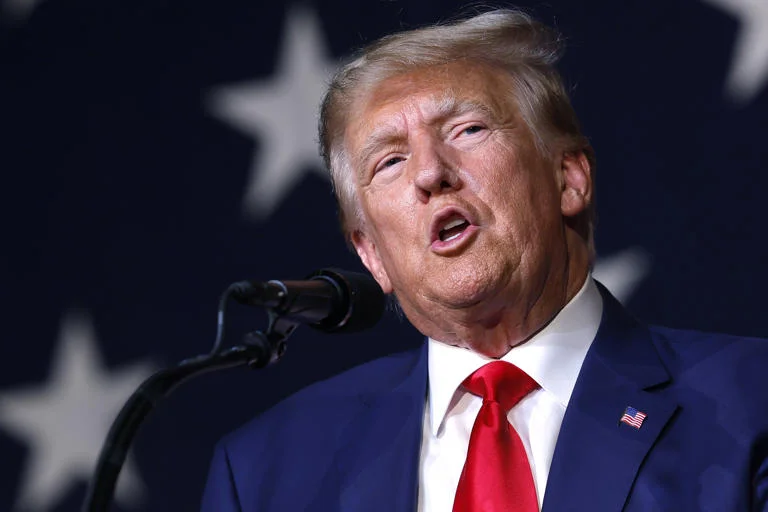
President Donald Trump says he wants America building tanks, not T-shirts.
Speaking to reporters on Sunday before boarding Air Force One, Trump made clear that his trade policies are designed to prioritise heavy industry and defence, not everyday consumer goods.
“We’re not looking to make sneakers and T-shirts,” he said. “We want to make military equipment. We want to make big things. We want to do the AI thing.”
It’s a sharp signal of where Trump sees the future of American manufacturing — not in cotton mills, but in chip plants and shipyards.
Trump was responding to earlier comments by Treasury Secretary Scott Bessent, who last month said the U.S. “doesn’t necessarily need a booming textile industry.” That remark sparked pushback from the National Council of Textile Organizations, which represents an industry that still employs thousands.
Doubling down, Trump added:
“I’m not looking to make T-shirts, to be honest. I’m not looking to make socks. We can do that very well in other locations. We are looking to do chips and computers and lots of other things, and tanks and ships.”
Critics Sound the Alarm
Not everyone agrees with the president’s vision. The American Apparel & Footwear Association (AAFA) warned that higher tariffs could hurt both U.S. manufacturers and American families.
“With 97% of the clothes and shoes we wear being imported… more tariffs will only mean higher input costs for U.S. manufacturers and higher prices that will hurt lower-income consumers,” said Steve Lamar, AAFA’s president, in a statement.
Trump’s remarks come just days after he shocked markets by calling for a 50% tariff on European Union goods. He also floated the idea of a 25% tax on imported iPhones. That plan has not yet been formalised.
On Sunday, he softened his stance slightly, giving the EU until 9 July to negotiate before the tariffs take effect.
The Politics of Production
Trump’s push to revive U.S. manufacturing has been central to his political brand since his first presidential run in 2016. He repeated the message in 2024, appealing to working-class voters in the Midwest and beyond.
Many of those jobs, especially in textiles, have disappeared over the past few decades as companies shifted production overseas in search of lower costs.
By imposing tariffs and encouraging domestic investment, Trump says he’s keeping his promises. But critics argue the global economy isn’t so easily untangled.
The U.S. still relies on foreign supply chains — especially for clothing, shoes, and electronic components. Some economists say a sharp turn inward could raise prices and spark trade wars.
Trump’s supporters see it differently. They say America should be less dependent on countries like China, especially for critical industries like defence and technology.
Whether that means turning away from socks and shirts entirely remains to be seen.
But for now, Trump’s message is clear: think tanks, not tank tops.
About the Author