
Former President Uhuru Kenyatta has begun redefining his role in Kenya’s 2027 political contest, stepping away from the day-to-day leadership of Jubilee Party while positioning Fred Matiang’i to negotiate the party’s place in an emerging opposition alliance.
Kenyatta’s speech at Jubilee headquarters in Nairobi on Tuesday contained sharp responses to President William Ruto, but its more significant message was about succession and coalition-building.
The former president proposed that Matiang’i take over his position, subject to approval by Jubilee’s National Delegates Convention, while he retreats to what he described as a “senior adviser” role.
“I cannot leave Jubilee. Where would I go? Do I have another home?” Kenyatta told supporters before proposing that he move “upstairs” to become a senior adviser.
He then asked members to endorse Matiang’i.
“Mkubali mumpokee Fred Okengo Matiang’i achukue nafasi yangu,” he said — accept Fred Okengo Matiang’i to take my place.
The move potentially gives Matiang’i an established political vehicle while allowing Kenyatta to retain influence without being the party’s frontline leader.
But Kenyatta made clear that he does not envisage Jubilee going into 2027 alone.
He said the party needs a candidate who can engage other political formations and later urged Matiang’i to “join hands with the other leaders” and work with them.
That points to coalition negotiations becoming the next stage of Jubilee’s strategy.
Uhuru answers Ruto
Kenyatta also used the speech to answer Ruto’s repeated criticism of his former administration and recent portrayal of him as a political “sponsor” behind opposition activity.
“After four years they are still saying Uhuru this, Uhuru that,” Kenyatta said.
“Were you given leadership so that you could continue talking about Uhuru, or were you given leadership so that you could go and work?”
Ruto has repeatedly contrasted his government’s record with Kenyatta’s administration and blamed some economic difficulties on inherited debt and policies.
Kenyatta, however, argued that four years into Ruto’s presidency, the current administration should be judged on its own performance.
He also addressed the “sponyo” and “rebel leader” labels that have entered the increasingly personal exchanges between the two leaders.
“Bado huko wananiita majina… sponyo, aka rebel sijui nini,” Kenyatta said.
“Is exercising your right to speak in a democratic country wrong?”
He asked whether he had instructed anybody to “take up arms”, arguing that citizens were free to express political opinions.
2022 dispute resurfaces
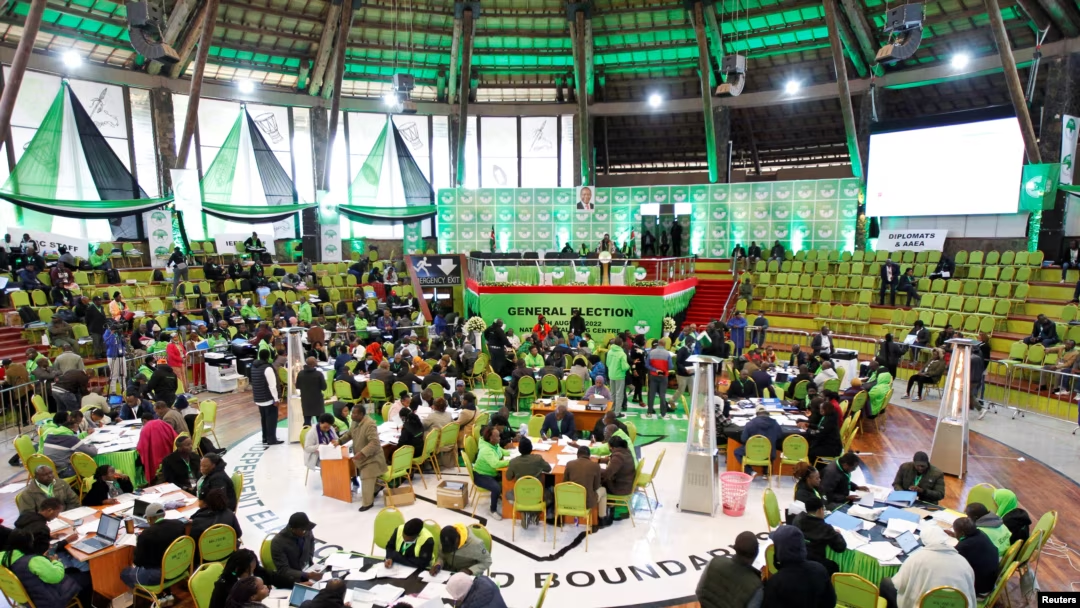
Kenyatta also revived one of Kenya’s most contentious political arguments by saying he still believes Raila Odinga won the 2022 presidential election.
“To this day, I know that he is the one who won that election,” Kenyatta said.
That remains Kenyatta’s political claim. The official result declared Ruto the winner with 50.49% against Odinga’s 48.85%, and the Supreme Court unanimously upheld Ruto’s election after considering petitions challenging the result.
Kenyatta nevertheless said Jubilee and its allies did not want a repeat of what he believes happened in 2022.
From candidate to kingmaker?
The emerging political significance of Kenyatta may therefore lie less in his public exchanges with Ruto and more in what he does behind the scenes.
He cannot seek another presidential term under the current Constitution, a point he acknowledged during Tuesday’s speech while stressing the need to respect the two-term limit.
Instead, Jubilee is preparing to recruit candidates for governor, Senate, National Assembly and county assembly seats while positioning itself for negotiations over the presidency.
“Twende kujipanga kazi ya 2027,” Kenyatta told supporters — let us organise for the work of 2027.
The shift leaves Matiang’i with the immediate task of rebuilding Jubilee and negotiating with other opposition leaders, while Kenyatta potentially assumes the less visible but politically influential role of adviser and coalition broker.
That may ultimately prove more consequential for 2027 than the continuing war of words between Kenya’s fourth and fifth presidents.
About the Author