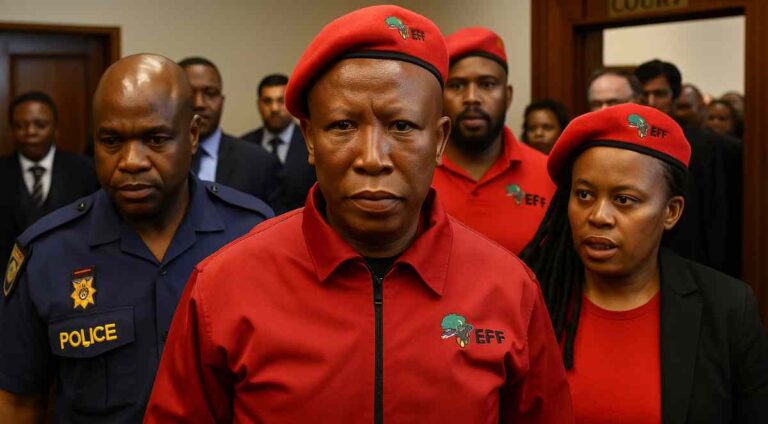
JOHANNESBURG — Julius Malema, the outspoken leader of South Africa’s Economic Freedom Fighters (EFF), has been found guilty of discharging a firearm in public — a conviction that could see him sentenced to as many as 15 years in prison.
The ruling, delivered on Tuesday by Magistrate Twanet Olivier, stems from a 2018 incident when Malema was filmed firing several live rounds into the air during a party rally in the Eastern Cape. The event marked the EFF’s fifth anniversary, and the crowd numbered around 20,000.
Prosecutors accused Malema of recklessly endangering lives by firing between 14 and 15 shots from the stage. He faced multiple charges, including unlawful possession of a firearm and ammunition, reckless endangerment and the discharge of a weapon in a public space. His former bodyguard, Adriaan Snyman, who was charged alongside him, was acquitted.
Malema denied wrongdoing, insisting the firearm was not his and that he pulled the trigger to excite supporters. “It was not my gun,” he told the court during the trial.
The case took three days of deliberation before the magistrate declared, “You are found guilty as charged.” Sentencing has been postponed to January 2026.
This is Malema’s second conviction in less than two months. In August, the equality court found him guilty of hate speech after remarks he made about white South Africans, saying: “No white man is going to beat me up… you must never be scared to kill. A revolution demands that at some point there must be killing.”

The court ruled the comments incited harm. Malema and his party argued they were taken out of context.
His prosecution over the firearm incident followed a complaint by AfriForum, an Afrikaner civil rights group that has long clashed with Malema and the EFF. The organisation has also been a driving force behind several hate speech cases against him.
Malema, 44, has built a political career on fiery speeches and populist positions that often divide opinion in South Africa. To his supporters, he is a champion for the poor and a fierce critic of entrenched inequality. To his detractors, he is a provocateur who inflames racial tensions in a country still grappling with the legacy of apartheid.
With sentencing set for January, the case raises fresh questions about Malema’s political future and whether his growing list of legal troubles could threaten his role as one of South Africa’s most polarising opposition figures.
About the Author