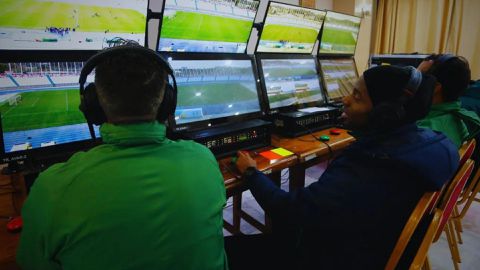
At the Ulinzi Sports Complex in Nairobi, whistles and screens replaced goals and chants. On Tuesday, the Confederation of African Football (CAF) invited journalists to step inside the referee’s world, lifting the veil on one of football’s most debated tools — the Video Assistant Referee.
The timing could not have been sharper. CHAN 2024 is nearing its end, and conversations around officiating have been fierce. The disallowed goal by Kenya’s Ryan Ogam against Madagascar in the quarter-finals triggered uproar across terraces and timelines. Many asked: who really makes the call — the referee or the machine?
Victor Gomez, vice-chair of CAF’s referees committee, sought to answer that. Speaking to the room, he described the tension officials face when the replay exposes an error. “One of the worst feelings is making a decision you think is correct, only to see later that you were wrong,” Gomez said. “That is why VAR matters. It gives referees a chance to confirm or correct themselves. VAR is here to stay; it is the future of refereeing.”
But VAR, participants were reminded, does not wield the whistle. Kenyan referee Dickens Mimisa made that point clear. “The referee makes the decision. VAR only asks you to take another look. You can stick with your call or change it,” he said. “The danger comes when both the referee and VAR get it wrong. That is when it becomes very difficult for organisers.”
The workshop was not only about screens and rules. It also celebrated progress in representation. Diana Chikotesha, the Zambian official who last year became the first woman to officiate an Africa Cup of Nations final, spoke of breaking barriers. “Being female in a male-dominated field is not easy. It takes determination, hard work and passion for the game. More women are rising, and they are excelling,” she told the gathering.
CAF’s Technical Director, Mohammed Zidane, explained VAR’s role in simple terms. “It is not there to control. It is there to help. If the referee makes the right call, VAR confirms it. If something is missed, VAR highlights it instantly,” he said.
Journalists were also guided through referees’ match-day routines — from briefings to simulation drills — offering a rare glimpse into the preparation that precedes the 90 minutes fans usually see.
For CAF, the day-long exercise was about more than transparency. It was about trust. With the continent’s eyes on CHAN 2024, officials want supporters to understand the process, not just the outcomes. In doing so, they hope to bridge the gap between fans, referees and the game itself.
About the Author