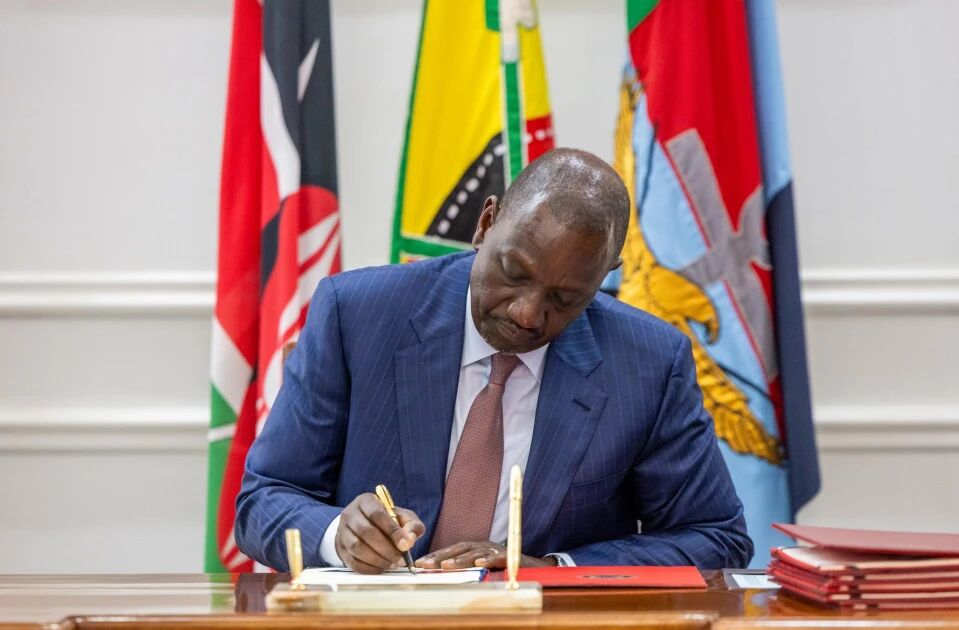
President William Ruto has signed two landmark bills into law aimed at curbing corruption in public service and strengthening protections for Kenya’s vulnerable populations. During a signing ceremony at State House Nairobi on Wednesday, July 30, Ruto assented to the Conflict of Interest Bill, 2023 and the Social Protection Bill, 2025, both sponsored by National Assembly Majority Leader Kimani Ichung’wah.
The Conflict of Interest Bill repeals the Public Officer Ethics Act and consolidates scattered provisions under one framework. It gives the Ethics and Anti-Corruption Commission (EACC) sole oversight over public officers’ conduct, aligning with Article 79 of the Constitution.
The law bars public officers from using their positions for personal gain or to benefit others unfairly. It prohibits involvement in business dealings with their own institutions, bans preferential treatment not sanctioned by law, and blocks officers from seeking private employment while still serving the government.
Public officials must now recuse themselves from any decisions involving their personal interest and must declare all income, assets, and liabilities, including those of spouses and dependents.
Deputy President Kithure Kindiki hailed the bill, calling it a decisive step against entrenched corruption. “This new law closes loopholes that officials have used to siphon public funds. It also cuts off the use of proxies to shield corrupt dealings,” Kindiki said.
The Social Protection Bill, 2025 introduces a rights-based, non-contributory social welfare system. It proposes a life-stage approach to support beginning in early childhood and extending into old age through state-funded programs.
The law establishes a National Social Protection Board, led by a presidential appointee, to coordinate national safety net programs. These include cash transfers, feeding initiatives, psychosocial support, and assistive devices for persons with disabilities.
County governments are expected to localize implementation, maintain updated records of vulnerable residents, and allocate resources for the programs. The law defines beneficiaries as orphans, persons with disabilities, elderly citizens in poverty, victims of disasters, and unpaid caregivers. However, the Cabinet Secretary for Social Protection may expand the list to include other at-risk groups.
To access support, individuals will undergo a formal registration and assessment. Appeals for denied applications can be filed within 30 days to the Cabinet Secretary or escalated to the High Court.
A Social Protection Fund, to be managed by the National Treasury, will finance the programs.
Both laws mark a strategic move by the Ruto administration to tighten public accountability and expand government-supported welfare. In his address, Ruto said these reforms are part of his broader promise to build a fair, accountable, and inclusive government that prioritizes integrity and care for its citizens.
About the Author