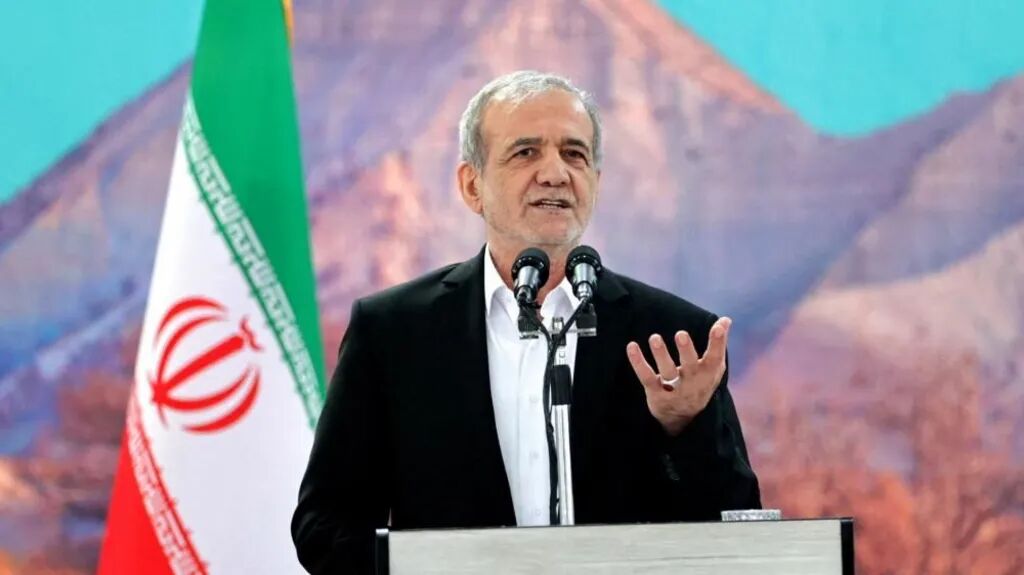
was reportedly injured during an Israeli airstrike on a secret underground military facility in Tehran on June 16, according to new claims by Iranian state-linked media.
Fars News Agency, which maintains close ties to Iran’s Islamic Revolutionary Guard Corps (IRGC), stated that six bombs struck the access points of the classified compound during an emergency session of Iran’s Supreme National Security Council. President Pezeshkian, who was attending the meeting at the time, is said to have suffered injuries to his leg while escaping through an emergency exit shaft.
The report has not been independently verified. Israel has not issued a public response to the allegation.
The compound, described as a deep-underground facility near the northwestern edge of Tehran, reportedly lost all power and ventilation following the blast. The agency said all entry and exit routes were blocked by the precision strikes, which also cut electricity to the site. Despite the damage, Pezeshkian and other top officials reportedly reached safety.
The Supreme National Security Council is Iran’s most powerful decision-making body after Supreme Leader Ayatollah Ali Khamenei.
Footage posted online during the 12-day conflict between Israel and Iran last month showed repeated strikes in the same mountainous area. It now appears that at least one of those attacks targeted the Tehran bunker where Iran’s senior leadership had gathered during the escalation.
Last week, Pezeshkian publicly accused Israel of attempting to assassinate him. Israeli Defense Minister Israel Katz dismissed the claim, stating that regime change in Tehran was not the objective of the military campaign. However, Israeli officials have admitted that Ayatollah Khamenei was a primary target in the early stages of the war, although he reportedly managed to relocate to a secure, undisclosed site beyond Israel’s reach.
At the start of the June conflict, Israeli strikes killed multiple high-ranking IRGC and military commanders. Iranian officials later acknowledged that their leadership was caught off guard and that command coordination was severely disrupted during the first 24 hours of the assault.
The Israeli air campaign began on June 13 with surprise attacks on nuclear and military infrastructure across Iran. Israeli authorities said the operation was designed to stop Tehran from advancing toward nuclear weapons capability. Iran, however, denies pursuing nuclear arms and maintains that its uranium enrichment is for peaceful energy and research purposes.
Nine days later, on June 22, the United States followed with coordinated air and missile strikes on three nuclear sites in Iran. President Donald Trump described the U.S. strikes as having “obliterated” the facilities, though intelligence agencies have issued more measured assessments.
The incident involving President Pezeshkian has raised broader concerns about how Israel obtained detailed intelligence on the locations of Iran’s leadership and secured compounds. Iranian authorities have launched investigations into possible infiltration by Israeli agents.
The full extent of the damage to Iran’s leadership and strategic infrastructure remains unclear, and both sides continue to release limited and conflicting information as tensions in the region remain high.
About the Author