In a world often pulled between extremes, ancient Greek philosopher Aristotle proposed a simple but lasting idea: moral virtue lies in the middle. This principle, known as the golden mean, defined ethics not by rigid rules or sweeping absolutes, but by moderation between two vices one of excess and the other of deficiency.

The golden mean first took shape in Aristotle’s Nicomachean Ethics, written in the 4th century BCE. In it, he argued that a virtuous life requires balance. Courage, for example, is the mean between recklessness and cowardice. Generosity stands between wastefulness and stinginess. Aristotle wrote, “Virtue, then, is a state of character concerned with choice, lying in a mean… this being determined by reason and by that reason by which the man of practical wisdom would determine it.”

His teachings built on older ideas. The phrase “nothing in excess” was engraved at the Temple of Apollo in Delphi, long before Aristotle’s time. In myth, Daedalus warned his son Icarus to fly between the sun and the sea, a call for balance that ended in tragedy when Icarus ignored him.

Plato, Aristotle’s teacher, also praised moderation. In Philebus, Plato described the good as a mix of truth, beauty, and proportion. In Republic, Socrates named moderation, along with wisdom and courage, as essential virtues in a just society.
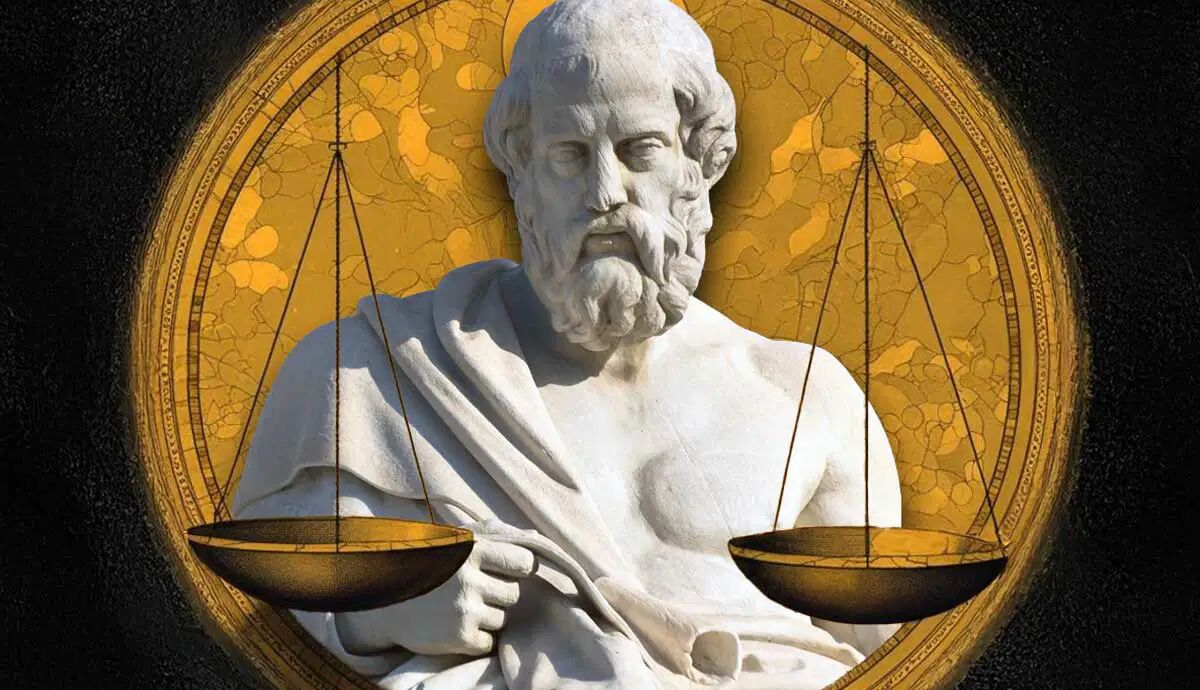
But Aristotle gave the concept clearer structure. He identified moral virtues such as patience, honesty, and modesty, each lying between two opposing flaws. He taught that the right action depends not just on avoiding extremes but on doing the right thing at the right time for the right reason.
In Aristotle’s own words, courage means feeling fear and confidence “at the right times, about the right things, toward the right people, for the right end, and in the right way.” He compared virtues to health, saying that both can be lost through too much or too little. Just as overtraining damages the body, excessive emotions can harm the soul.
This ethical model later shaped thinkers across cultures. In Judaism, Moses Maimonides praised the middle path, calling it “the way of the wise.” He urged people to resist their instincts when those instincts veer too far toward one side.
Buddhist teachings also echo the golden mean. The Buddha spoke of the Middle Way, avoiding both indulgence and self-denial. Confucius emphasized harmony between extremes in personal conduct, while Islamic tradition calls for a balanced nation, warning against both greed and asceticism.
Christian philosopher Thomas Aquinas argued that moral evil results from straying from the right measure either by excess or by falling short. He wrote, “Moral virtue observes the mean.”
While the golden mean evolved through cultures and belief systems, its core remains constant: balance creates harmony. Today, this principle applies to everything from politics to mental health. Experts stress the importance of measured responses in leadership, moderation in economic policy, and even balance in personal lifestyle choices like diet and technology use.
In a time marked by polarization and extremes, Aristotle’s golden mean reminds us that virtue lives not in shouting from either side but in walking a steady path between them. His message is clear: strength lies in balance, and wisdom requires knowing where the center is.
About the Author