
The National Environment Management Authority (NEMA) in partnership with United platform Solutions (UPS) has today launched the Kenya Online Continuous Emission Monitoring System (KOCEMS).
According to NEMA and UPS, KOCEMS is a national digital infrastructure designed to monitor, report and manage environmental emissions from industrial facilities in real time.
Speaking at the launch, Kenya’s Cabinet Secretary for Environment, Climate Change and Forestry, Deborah Barasa, said air pollution has become one of the continent’s most serious public health threats.
“Air pollution remains a major environmental and public health challenge across Africa,” she said. “It contributes to more than 1.1 million premature deaths every year.”
Dr Barasa said the new monitoring system would help authorities enforce environmental rules more effectively while giving policymakers reliable data to guide decisions.
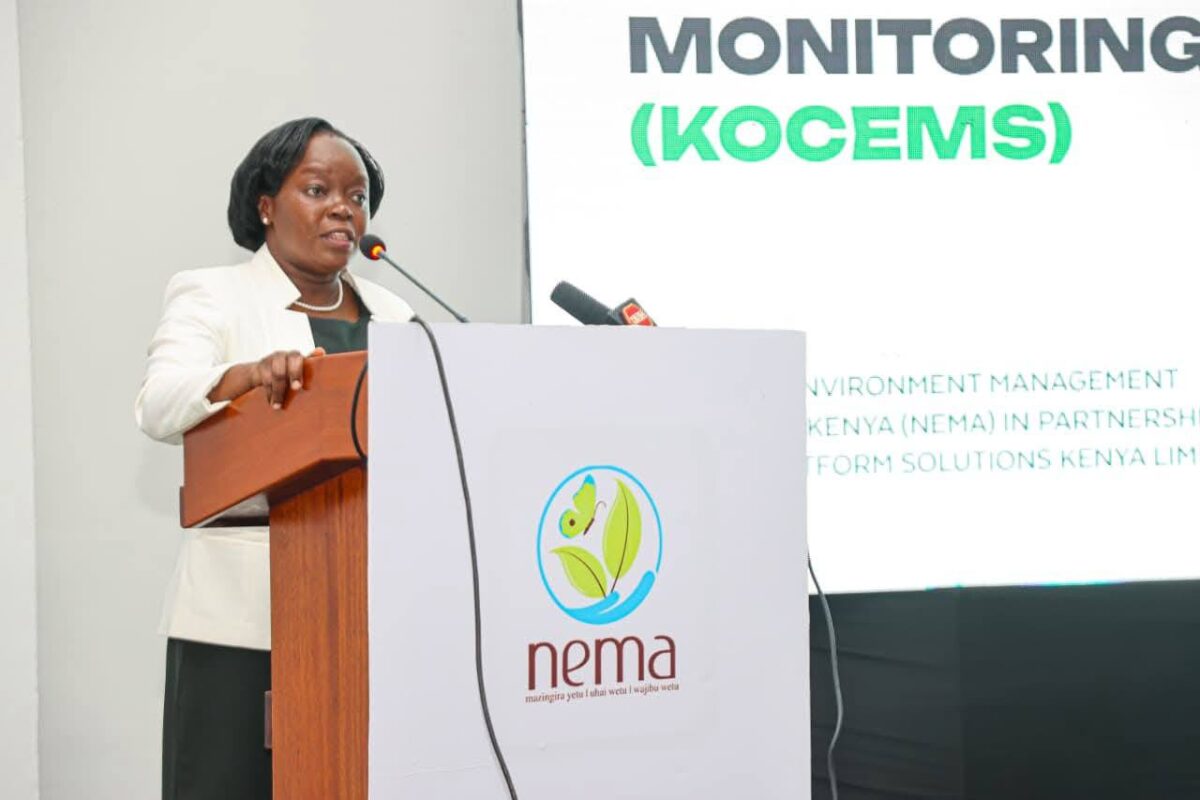
“This is an important step in strengthening compliance and protecting both public health and the environment,” she said, urging industries to work closely with regulators to ensure the system works as intended.
The event was attended by David Ong’are, NEMA’s Director of Environmental Compliance, who represented the agency’s Director General.
In a statement, the Director General, Mamo B. Mamo, said the initiative is rooted in Kenya’s updated air quality regulations. Under Regulation 59 of the Environmental Management and Coordination (Air Quality) Regulations, 2024, certain industries must install continuous emissions monitoring equipment that sends data directly to the authority.
The system will collect information from factories, cement plants, refineries and power stations. Sensors placed at these facilities will measure pollutants and transmit the data to a central platform where regulators can review it in real time.

NEMA officials say this will give the agency a clearer picture of pollution levels across the country and allow quicker responses when limits are exceeded.
Beyond industrial emissions, the platform is also expected to support broader environmental monitoring. Authorities say it will help track trends in air, water and noise pollution nationwide.
Dr Barasa also used the occasion to urge Kenyans to support tree-planting efforts during the current rainy season, calling on citizens to plant and protect up to half a billion tree seedlings.
Environmental groups have long warned that pollution from urban growth and industry is placing increasing strain on Kenya’s air quality, particularly in major cities such as Nairobi.
Officials say the new monitoring system is intended to give regulators the tools they need to keep pace with that growth, and to ensure industries meet environmental standards.
About the Author