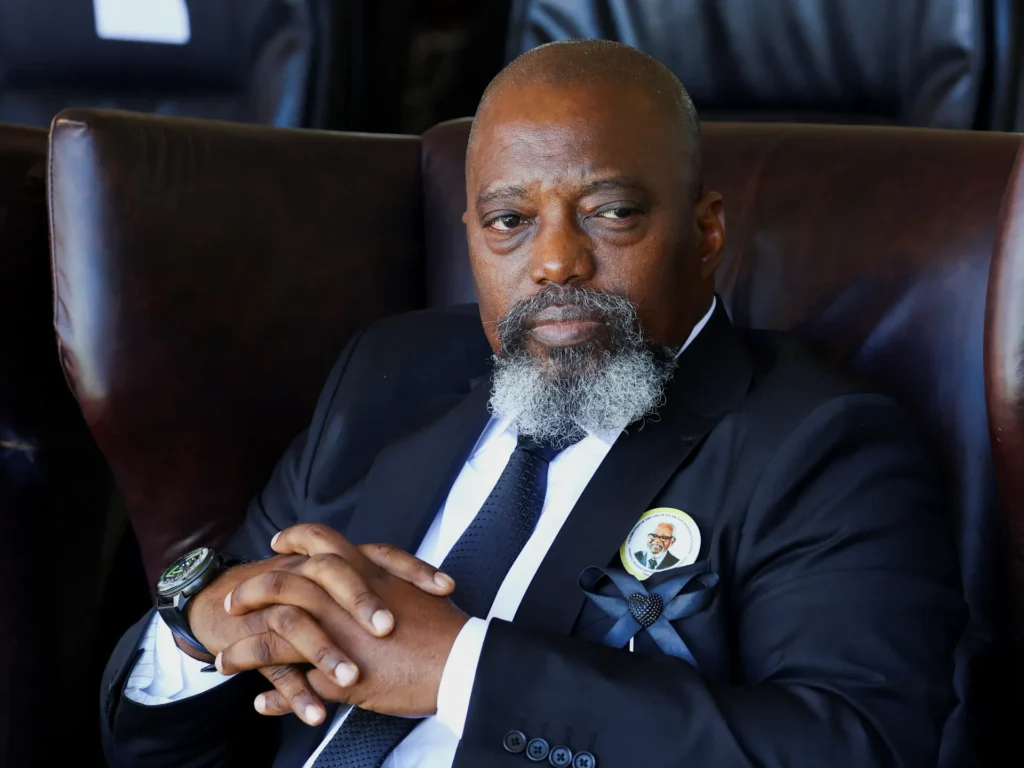
KINSHASA — Joseph Kabila, the former president of the Democratic Republic of Congo, has been sentenced to death in absentia by a military tribunal that found him guilty of treason, war crimes and crimes against humanity.
The verdict, delivered in Kinshasa on Tuesday, accused the 53-year-old of backing the M23 rebellion that has seized wide areas of the country’s east. The charges included murder, sexual assault, torture and leading an armed insurrection.
Lieutenant-General Joseph Mutombo Katalayi, who presided over the case, said the ruling left no doubt. “In applying Article 7 of the Military Penal Code, it imposes a single sentence, namely the most severe one, which is the death penalty,” he told the court. Kabila was also ordered to pay damages worth an estimated $50 billion to the state and to victims.
The former leader, who governed from 2001 to 2019, did not appear in court and was not represented by lawyers. His current whereabouts are uncertain. He has previously dismissed the charges as politically motivated, calling the judiciary “an instrument of oppression.”
The ruling comes at a time of deep political tension. President Félix Tshisekedi, Kabila’s successor, has long accused him of sponsoring the resurgence of the M23, which has pushed thousands from their homes and left scores dead in North and South Kivu provinces. Earlier this year, at the Munich Security Conference, Tshisekedi alleged that Kabila was fuelling the insurgency.
M23’s advance has been devastating. The United Nations estimates that hundreds of thousands have been displaced in the past year alone. In June, both sides signed a U.S.-brokered ceasefire, but clashes have continued, with each blaming the other for breaking the accord.
The regional picture is just as fraught. Rwanda, often accused by Kinshasa of backing the rebels, insists its involvement is limited to protecting its territory from Congolese forces and Hutu militias linked to the 1994 genocide. Kigali denies any sponsorship of M23.
The verdict against Kabila risks inflaming divisions in a country already struggling with cycles of conflict and contested authority. Supporters of his People’s Party for Reconstruction and Democracy (PPRD) have described the ruling as a political purge. Tshisekedi’s government has meanwhile moved to suspend the party and seize the assets of its senior figures.
Kabila spent nearly two decades in power, resisting international pressure to step down until mass protests forced elections in 2018. He left office after an uneasy deal that briefly tethered him to Tshisekedi. But the alliance fractured, and by 2023 Kabila had largely relocated to South Africa, occasionally appearing in eastern Congo — including in Goma earlier this year, where he met religious leaders.
Whether the sentence can be enforced remains an open question. But it underlines a dramatic fall from grace for a man who once held firm control of one of Africa’s most resource-rich nations.
About the Author