
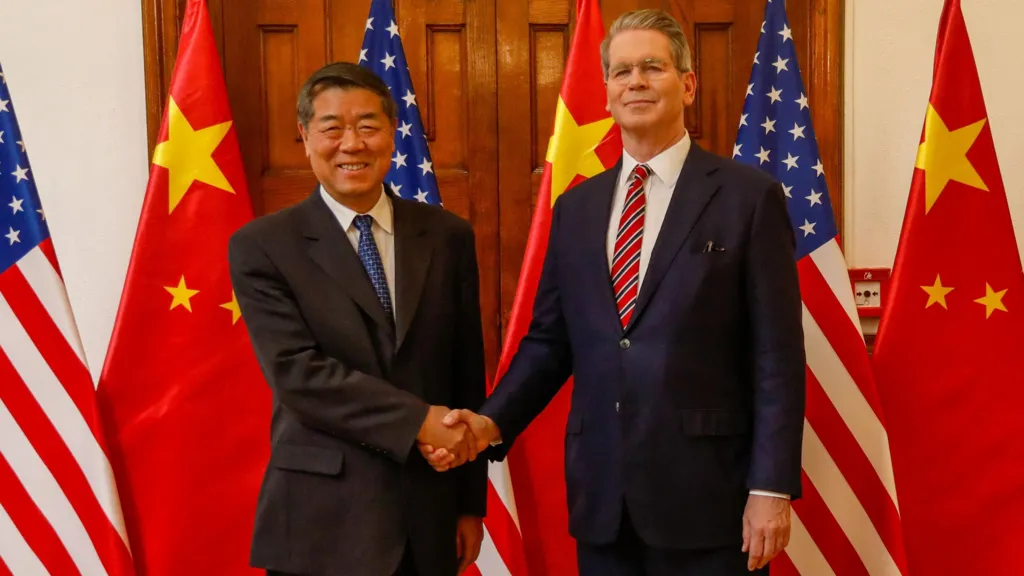
US and Chinese officials returned to the negotiating table in Madrid on Monday, seeking to ease tensions in a trade dispute that has dragged on for years. But hanging over the talks is a separate flashpoint: the fate of TikTok in America.
The discussions, hosted at Spain’s Santa Cruz Palace, are being led by Treasury Secretary Scott Bessent for Washington and Vice Premier He Lifeng for Beijing. Both sides met in July, when they agreed to pause a fresh round of tariffs for 90 days. That truce expires on 10 November.
For now, the focus is not only on tariffs. The clock is ticking for TikTok’s Chinese parent company, ByteDance, to sell its American operations or face a ban. The deadline is Wednesday.
President Donald Trump, who once pressed hard for TikTok to be barred, has shifted tone. Asked about the app on Sunday, he said: “We may let [TikTok] die. Or we may… I don’t know. It depends. Up to China, it doesn’t matter too much.”
The remark added to speculation that the White House will push back the deadline again. It would be the fourth such extension. Last month, Trump downplayed national security concerns tied to the app, calling them “highly overrated”.
TikTok’s popularity has complicated Washington’s position. The platform counts about 170 million users in the United States, and Trump himself gained traction there during his 2024 election campaign. The White House even opened an official account in August.
Still, trade remains the backbone of the Madrid talks. The July agreement cut import duties that had soared to more than 100 percent on some goods. Officials said the pause was meant to give time to resolve disputes over “unfair trade practices” and security matters.
Diplomats are now working toward a possible meeting between Mr Trump and Chinese President Xi Jinping as soon as October, when both leaders are expected at a summit in South Korea.
For all the progress, mistrust lingers. Washington has long accused Beijing of tilting the economic playing field, while China bristles at what it sees as American overreach. The TikTok deadline has become a symbol of that broader struggle—part trade dispute, part tech rivalry, and part political theatre.
About the Author