

KATHMANDU — Nepal is reeling after days of violent anti-corruption protests left 22 people dead and forced Prime Minister K.P. Sharma Oli to resign. The unrest, led largely by young people, erupted after the government imposed — then hastily repealed — a controversial social media ban.
Thousands poured into the streets of Kathmandu and other cities on Monday, some carrying banners reading simply: “Gen Z Against Corruption.” What began as peaceful demonstrations quickly spiralled into chaos.
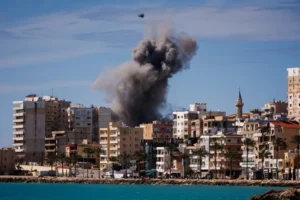
Police fired tear gas, rubber bullets and, by some accounts, live rounds. Protesters stormed government buildings, scaled the walls of parliament, and by Tuesday, set it alight.
“This is not just about Facebook,” said Pratiksha Adhikari, a 22-year-old student protesting in Kathmandu. “It’s about years of corruption, lies, and no future for people like us.”
A Ban, a Backlash, and a Boiling Point
The protests were triggered last week when the government abruptly banned 26 popular social media platforms — including WhatsApp, Instagram and Facebook — for failing to register with the Ministry of Communication and Information Technology.
The ban was framed as a legal requirement, but critics saw it as an authoritarian move designed to stifle dissent.
“It looked like a deliberate attempt to silence criticism,” said Bishal Rai, a digital rights advocate in Kathmandu. “That backfired spectacularly.”
The government repealed the ban on Monday night, but by then the anger had spilled into the streets.
Casualties and Clashes
By Tuesday evening, the death toll stood at 22. Nineteen were killed in Monday’s clashes alone, according to hospital officials. Most were young. Nearly 200 others have been injured — many from gunfire and beatings. Police say several officers were also hurt.
Hospitals are overwhelmed. At Bir Hospital, staff reported treating multiple gunshot wounds. Crowds have gathered outside, some in search of missing relatives, others to donate blood.
In the capital, protesters set fire to the federal parliament building, as well as the headquarters of the Nepali Congress Party and the residence of former Prime Minister Sher Bahadur Deuba. Homes of several other politicians were also vandalised.
Police enforced curfews and blocked roads around key government buildings. Helicopters buzzed overhead. Armoured vehicles patrolled the streets.
Leadership Vacuum
In a brief statement from his office on Tuesday morning, Mr Oli announced he was stepping down “to allow space for a constitutional resolution.” But the resignation has done little to calm the streets — or clarify who is now in charge.
Nepal’s army chief, General Ashok Raj Sigdel, made an unusually direct address later that evening, accusing “unruly elements” of using the protests as cover for looting and arson. He warned that the military was ready to “take control” if the situation worsened.
“We urge restraint,” he said, while extending an invitation to protesters for dialogue.
Yet the protest movement has no clear leader. Organised largely through TikTok, Instagram and Telegram, it is a grassroots uprising — spontaneous, digital and largely decentralised.
One exception is Balen Shah, the independent mayor of Kathmandu, who has voiced support for the protests. “Young people are speaking,” he said in a post on X (formerly Twitter). “The state must listen — not shoot.”
A Generation’s Reckoning
Unlike past movements led by political parties or trade unions, this uprising belongs to a younger generation — one that has grown up in a democratic Nepal, but seen little to show for it.
Nepal ranks among the poorest countries in South Asia. Corruption scandals are frequent. Public services are underfunded. And unemployment, especially among the youth, remains high.
For many protesters, the social media ban was simply the last straw.
Videos circulating online show schoolchildren in uniform chanting slogans, university students holding up textbooks while marching, and local artists painting murals that read: “We Are Not Your Future — We Are Your Present.”
What Comes Next?
With no government in place and no protest leaders to negotiate with, Nepal faces deep uncertainty.
The military has not explicitly threatened a takeover, but its presence on the streets is growing. International observers, including human rights groups, have called for calm and accountability.
“The government must investigate the killings and hold those responsible to account,” said Meenakshi Ganguly, Deputy Asia Director at Human Rights Watch. “The use of force must be proportionate and lawful.”
For now, the crowds are not backing down.
“This is just the beginning,” said 19-year-old protester Saugat K.C., holding a handwritten sign that read, We Have Nothing Left To Lose. “They can’t ignore us anymore.”
About the Author