SYDNEY — A massive crowd of 90,000 protestors marched across the Sydney Harbour Bridge on Sunday, demanding a ceasefire in Gaza and the immediate opening of humanitarian corridors into the besieged Palestinian territory. Organized by the Palestine Action Group, the march began at Lang Park and stretched across the 1.2-kilometer bridge despite steady rainfall and strong police presence. Participants carried banners, Palestinian flags, and signs highlighting the starvation crisis in Gaza. The turnout, confirmed by New South Wales Police, far exceeded the initial projection of 10,000.

At the front of the march stood Julian Assange, newly returned to Australia, alongside former Foreign Minister Bob Carr and sitting federal MPs. A large banner reading “March for Humanity Save Gaza” led the crowd. “We’re here because people are starving, children are dying, and the world is watching,” Carr said. “This is not a conflict anymore it’s a blockade that is starving a population.”
Protesters were forced to turn back before completing the march after police issued a mass text message citing public safety concerns. A helicopter circled above, broadcasting instructions for the crowd to return to the city center. Protestors were denied access to the U.S. consulate, where the rally was scheduled to end.
Despite the disruption, the protest remained peaceful. Participants included families, faith groups, youth organizations, and members of Sydney’s Jewish, Christian, and Muslim communities.
“My sign says Jews 4 Gaza’ because I want to make it clear: this government doesn’t speak for all Jews,” said Dan, a protestor who identified as British-Jewish. “There’s no justification for cutting off aid to civilians.”
NSW Police officials described the situation as one of the most challenging public gatherings they had managed. Acting Assistant Commissioner Adam Johnson called it “a perilous situation,” noting crowd density concerns.
The Supreme Court had ruled in favor of the protest just 24 hours earlier, after police initially rejected the application. Under state law, blocking major roads during demonstrations can carry a fine of up to AUD $22,000 or two years in prison.
Premier Chris Minns had opposed the protest, warning it would cause “chaos.” Protesters and rights advocates accused the state government of trying to suppress dissent. “This was never about traffic,” Greens Senator Mehreen Faruqi said at the event. “This was always about silencing the public outcry over Gaza. And today, the people spoke anyway.”
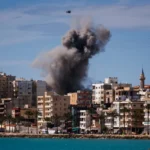
Since October, Gaza has faced a near-total blockade of food, water, medicine, and fuel. Aid organizations report that northern Gaza is experiencing famine-level conditions, with mass displacement and civilian casualties mounting. The World Food Programme said last week that 100% of Gaza’s population is in crisis or worse, with children bearing the brunt.
Australia’s federal government has urged restraint from all parties but stopped short of imposing sanctions or calling for a full ceasefire. MPs at Sunday’s protest urged stronger action.
Federal MP Ed Husic said, “People have seen enough. We’re talking about starving babies. There’s no room for neutrality.”
As the march concluded, protesters vowed to continue pressure on the government. Another protest is planned in Melbourne, where activists tried to block a major bridge but were met by riot police.
Julian Assange, speaking briefly to reporters after the event, said, “This isn’t about politics. This is about humanity. What’s happening in Gaza should never be allowed to happen again.”
The Sydney protest is part of a global wave of demonstrations demanding an end to the blockade and civilian protection in Gaza. Similar marches took place over the weekend in London, Berlin, and New York. Each called for a permanent ceasefire, unrestricted humanitarian access, and international accountability.
About the Author