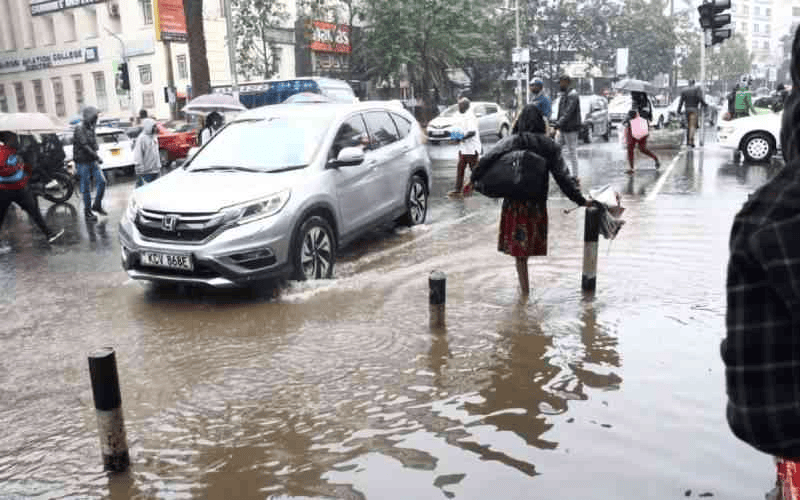
When the rains fall hard in Nairobi, the city all but drowns. Streets turn into rivers. Pavements disappear under muddy torrents. For many residents, the flooding has become a familiar nightmare.
The problem, lies not only in the skies but also in the ground beneath the city. Nairobi’s drainage system is outdated, poorly maintained and often blocked by garbage. Many have noted that the drainage infrastructure was designed decades ago and simply cannot cope with today’s population and urban growth.
Blocked drains worsen the problem. Construction debris and household waste clog water channels, leaving rainwater with nowhere to go. Illegal buildings on road reserves further narrow escape routes for floodwater.
The consequences are visible. Central business hubs such as Moi Avenue and Tom Mboya Street grind to a halt during heavy downpours. Roads become impassable, businesses close and commuters are stranded for hours.
The garbage problem runs deeper still. Nairobi generates tonnes of waste daily, yet much of it remains uncollected. Piles of rubbish are a common sight in many estates. When the rains come, the waste is swept into open drains and rivers, creating fresh blockages.
Public health experts warn that the impact is severe. Uncollected garbage attracts pests, while floodwaters mix with sewage, raising the risk of waterborne diseases. The Nairobi River basin is particularly hard-hit, as waste from informal settlements and nearby industries flows unchecked into the water.
The costs of flooding ripple across society. Families are displaced from their homes. Roads and buildings suffer damage. Businesses lose working hours. Traffic jams stretch for kilometres, costing the city millions of shillings in lost productivity.
City leaders acknowledge the scale of the crisis. Governor Johnson Sakaja has said Nairobi needs a “complete overhaul” of its drainage system, a project that would demand billions of shillings. Waste collection and disposal also need urgent improvement.
Geofrey Omatoke Mosiria, the city’s Chief Officer for Environment, has placed waste management at the center of his agenda. He has championed clean-up drives across informal settlements and pledged to step up enforcement against illegal dumping. Mosiria has also urged residents to take an active role. “A clean Nairobi is not only the government’s duty it is a shared responsibility,” he said, outlining plans to expand waste collection points and rehabilitate clogged waterways.
Yet many argue that infrastructure alone will not fix the problem. Strict enforcement of construction laws, stronger regulation of illegal dumping and public education campaigns are seen as essential steps. Local community groups have also called for more resident involvement in keeping neighborhood drains clear.
For now, the floods keep coming, carrying with them rubbish, sewage and the frustrations of a city still struggling to find its footing against the rain.
About the Author