
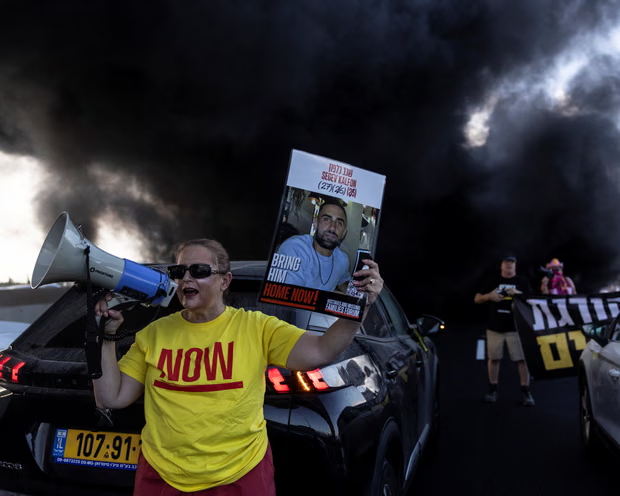
Families of Israelis still held in Gaza took to the streets on Tuesday, blocking highways and demanding their government strike a deal with Hamas to bring their relatives home.
The demonstrations, which began at dawn, shut down major roads connecting Tel Aviv and Jerusalem, including Route 1 and Route 443. Protesters also gathered outside the homes of senior government ministers, holding banners with the names and faces of the missing.
“We have a wonderful people but no government,” said Einav Zangauker, whose son Matan is among those still captive. “The government has abandoned, but the people will bring them back,” she told the crowd in Tel Aviv’s Hostages Square.
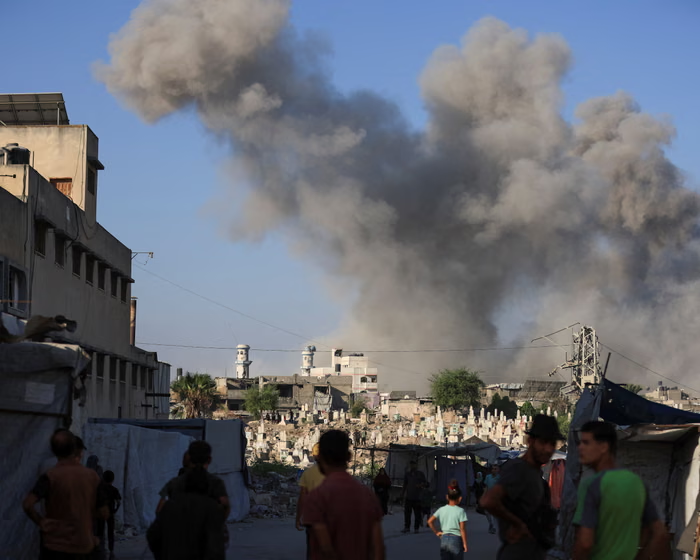
The protests coincided with mounting international outrage over an Israeli strike on Gaza’s Nasser hospital on Monday. Health officials in Gaza said at least 20 people, including five journalists, were killed in what they described as a double strike — the first missile hitting the hospital, the second landing as rescuers arrived.
Among the victims were Reuters cameraperson Hussam al-Masri, Al Jazeera photographer Mohammed Salama, and NBC journalist Moaz Abu Taha.
Prime Minister Benjamin Netanyahu’s office called the attack a “tragic mishap” and said the military had opened an investigation. But the explanation has done little to calm global criticism.
Canada’s foreign ministry said it was “horrified” by the incident, urging Israel to protect civilians and journalists. “Canada urges an immediate and permanent ceasefire, the protection of civilians, the unconditional release of the remaining hostages, and scaled-up UN-led humanitarian aid,” it posted on X.
In New York, Israeli foreign minister Gideon Sa’ar struck a defiant tone, accusing Western governments of trying to “force a Palestinian state” on Israel. “For us, it would be an act of suicide,” he told a gathering of American Jewish leaders.
Meanwhile, rights groups and foreign governments continue to pressure Israel on its conduct in Gaza and Lebanon. Amnesty International has called for an investigation into what it says is the deliberate destruction of civilian property in southern Lebanon, labelling it a possible war crime.
Australia also escalated tensions with Tehran, accusing Iran of directing antisemitic attacks on its Jewish community last year. Prime Minister Anthony Albanese announced the suspension of Iran’s ambassador and said his government would push to label the Islamic Revolutionary Guard Corps a terror group.
Back in Israel, the families of hostages vowed not to stop their campaign until a deal is reached. Tuesday’s actions were part of a nationwide “day of struggle” organised by the Hostages and Missing Families Forum.
Police eventually reopened the roads, warning that blocking highways endangered public safety. “Freedom of protest and expression is not freedom to harm others’ movement,” a police statement said.
But many protesters said disruption was the only way to keep pressure on their leaders. “Every day our loved ones remain in Gaza, we will remind this government of its duty,” said one demonstrator in Tel Aviv.
The crisis shows no sign of easing, with war still raging in Gaza and grief mounting on both sides.
About the Author