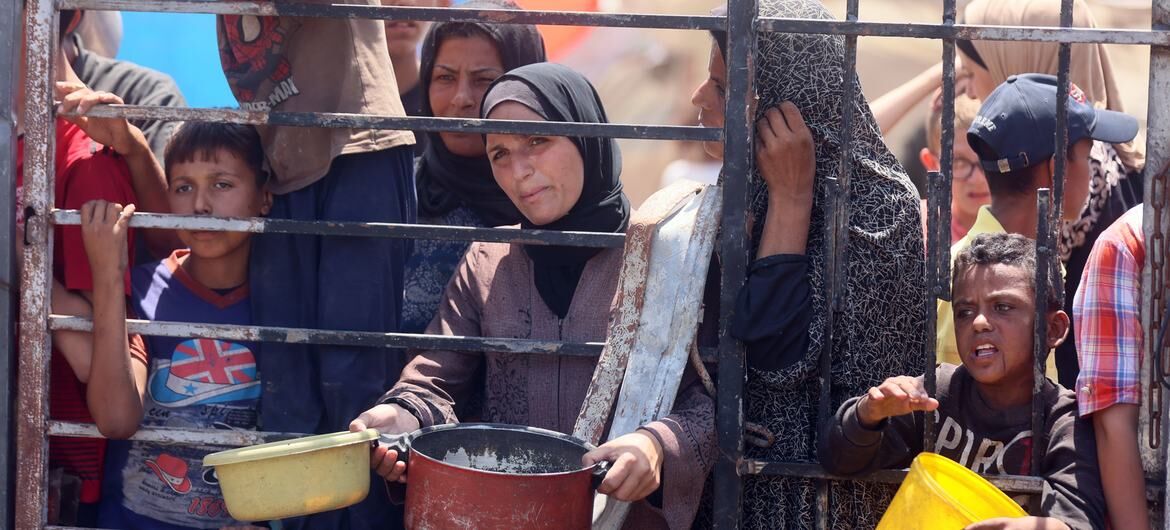
More than 1,300 Palestinians have been killed while trying to access food in Gaza aid sites, according to a new report by the United Nations, which warns that Israel’s ongoing military strikes are worsening an already catastrophic humanitarian situation.
Between May 27 and July 31, at least 1,373 people died while approaching aid convoys or waiting near humanitarian food sites, the UN Human Rights Office in the occupied Palestinian territory said on Friday. The report highlights continued attacks despite Israel’s July 27 announcement of daily pauses in military operations along western Gaza corridors to improve humanitarian access.
On July 30 and 31 alone, 105 people were killed and more than 680 injured in airstrikes and ground fire near food convoy routes and Gaza Humanitarian Foundation (GHF) aid locations. The targeted areas included the Zikim route in North Gaza, southern Khan Younis, Middle Gaza, and Rafah.
The UN office stated it had no information suggesting those killed were taking part in hostilities or posing any threat to Israeli forces.
“Each person killed or injured had been desperately struggling for survival not only for themselves, but also for their families and dependents,” the UN said.
The UN office emphasized that intentionally attacking civilians who are not taking part in combat, and using starvation as a method of warfare, violate international humanitarian law.
“Intentionally directing attacks against civilians and depriving them of objects indispensable to survival such as food are war crimes,” UN statement read. “If part of a widespread or systematic attack on the civilian population, these may also amount to crimes against humanity.”
The UN called for independent investigations into each killing and for accountability measures to be implemented without delay. While food supplies inside Gaza remain critically low, UN agencies continue to push for the reopening of road crossings instead of relying on costly airdrops.
UNRWA Commissioner-General Philippe Lazzarini said airdrops are “at least 100 times more expensive than trucks” and deliver far less aid.
“If there is political will to allow airdrops which are highly costly, insufficient and inefficient and dangerous there should be similar political will to open the road crossings,” UNRWA Commissioner-General Philippe Lazzarini posted on social media.
UNRWA Commissioner-General Philippe confirmed that UNRWA has 6,000 trucks packed with humanitarian aid waiting to enter Gaza, but movement remains blocked.
Earlier this year, during a temporary ceasefire, UNRWA and other agencies managed to deliver between 500 and 600 aid trucks into Gaza each day. This, the agency said, helped reduce starvation and delivered aid without diversion.
“Aid reached the entire population of Gaza in safety and dignity,”UNRWA Commissioner-General Philippe Lazzarini said. “Let us go back to what works and let us do our job.”
The UN continues to call for unrestricted humanitarian access and a halt to violence against civilians trying to secure food and basic necessities. As the death toll climbs, pressure is mounting for concrete steps to protect the lives of Gaza’s most vulnerable.
About the Author