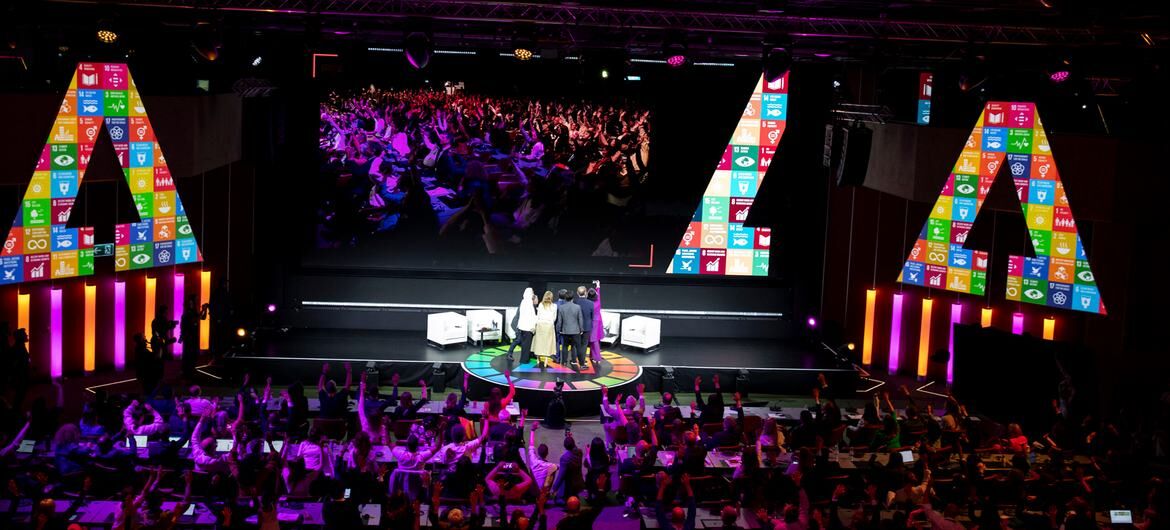
Geneva – The United Nations has launched a high-level summit in Geneva to confront growing concerns about artificial intelligence outpacing global regulation. The AI for Good Global Summit opened Tuesday, uniting world governments, researchers, and innovators to debate how AI can support human progress without deepening social and environmental harm.

The event, hosted at Geneva’s Palexpo center, comes as AI development surges. Systems capable of independent reasoning and decision-making are now advancing faster than the policies meant to guide them.

In her keynote, Doreen Bogdan-Martin warned, “The biggest risk we face is not AI wiping out humanity. It’s embedding AI everywhere without understanding its full impact on people and the planet.”
More than 200 live demonstrations are taking place across 20,000 square meters, including AI tools for emergency response, smart mobility, and water monitoring. Innovations range from a flying car to brain-computer interfaces and autonomous robots.
The summit focuses on steering AI toward the UN’s Sustainable Development Goals. Sessions this week will explore ethical AI, data protection, global oversight, and the technology’s role in healthcare, education, and climate response.
Thursday’s “AI Governance Day” will highlight the global policy gap. According to a new ITU survey, 85 percent of countries lack a national AI strategy, raising urgent concerns over inequality and fragmented regulation.
“This is the AI generation,” Bogdan-Martin said. “But being part of it means preparing society through education, access, and fairness for what AI truly means.”
Health remains a central focus. On Wednesday, the World Health Organization will lead a session on expanding access to AI-driven health innovation in low-income areas. Demonstrations include AI triage tools, diagnostic systems for rural clinics, and a preview of WHO’s upcoming technical brief on AI in traditional medicine.
Speakers will address the need for shared health data systems, regional cooperation, and legal clarity around intellectual property and algorithm use in medical care.

The summit also showcases youth innovators from marginalized communities, presenting AI solutions for disaster relief and sanitation. Projects include a self-cleaning mobile toilet, a biodiversity drone, and a fruit-picking robot powered by machine learning.

The AI for Good Awards will recognize outstanding projects using AI for social and environmental benefit.
Closing her remarks, Bogdan-Martin urged global unity: “Let’s never stop putting AI at the service of all people and our planet.”
The summit runs through Friday, with a final declaration expected to call for immediate, coordinated action to ensure AI advances human rights and equitable progress worldwide.
About the Author