
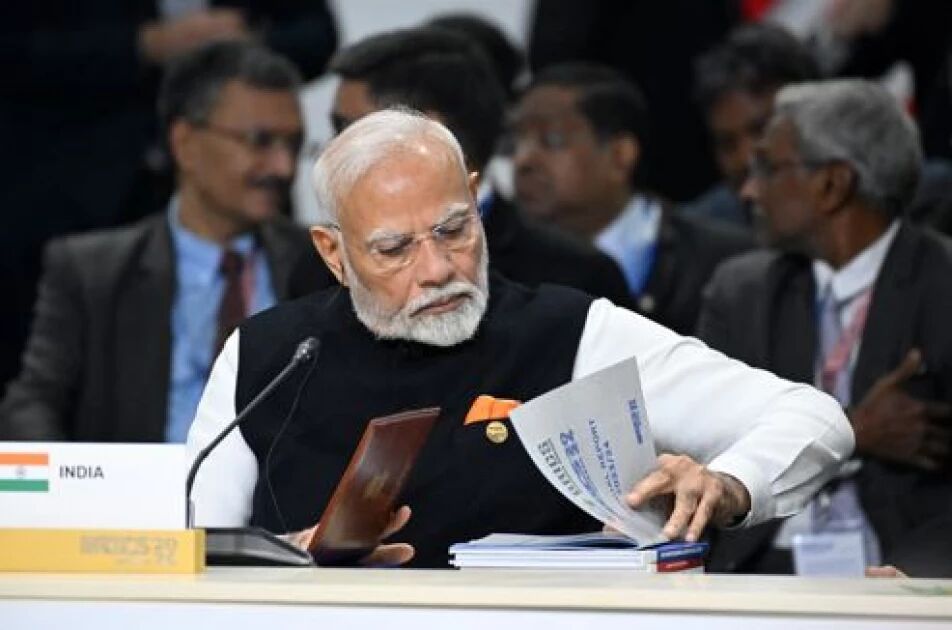
India and the United Kingdom signed a landmark free trade agreement on Thursday, cutting tariffs across key sectors including whisky, automobiles, textiles, and seafood. The deal was finalized during Indian Prime Minister Narendra Modi’s state visit to London, following more than three years of protracted negotiations. The agreement, signed at Chequers, British Prime Minister Keir Starmer’s official residence, is expected to raise bilateral trade by £25.5 billion ($34 billion) by 2040. The deal marks the UK’s most significant commercial pact since its departure from the European Union in 2020 and India’s most ambitious trade arrangement with a major developed economy.
“This agreement marks a new chapter for both our nations. It will make trade quicker, cheaper, and easier,” Prime Minister Starmer said, standing beside Modi. “We’ve entered a new global era, one that demands stronger partnerships.”
PM Modi described the pact as “a blueprint for our shared prosperity,” and emphasized expanded access for Indian exports, including jewelry, garments, and seafood.
The deal will immediately lower tariffs on Scotch whisky from 150% to 75%, with further reductions to 40% over a ten-year period. Duties on brandy and rum will also fall from current levels to 110%, and eventually to 75%.
Automotive tariffs which currently stand at up to 110% will be reduced to 10% over five years under a gradually widening quota system. In exchange, Indian electric and hybrid vehicles will gain access to the UK market under similar quotas.
British firms will benefit from tariff cuts on 90% of exports, reducing the average duty rate from 15% to 3%. Meanwhile, 99% of Indian exports to the UK, including textiles, will enjoy zero-tariff access.
Though the projected economic gain for Britain stands at £4.8 billion per year by 2040, the boost represents a modest uptick when compared to the country’s GDP of £2.6 trillion in 2024. According to the Office for Budget Responsibility, UK trade is still expected to lag by around 15% in the long run compared to pre-Brexit projections.
Beyond trade, the UK and India agreed to deepen cooperation on defense, climate policy, and crime prevention. The pact includes provisions for access to public procurement in India for British firms, particularly in clean energy projects. Service sectors, including insurance, are also covered.
The deal streamlines processes for temporary business travelers, though visa policy was not included. Workers posted temporarily between the two countries will now be exempt from dual social security contributions.
However, India did not secure an exemption from the UK’s upcoming Carbon Border Adjustment Mechanism, which will impose new taxes on high-emission imports starting in 2027.
Industry groups welcomed the agreement. Rain Newton-Smith of the Confederation of British Industry said the deal “sends a strong message in an era of rising protectionism.” India’s leading trade body also praised it as a “solid base for expanded market access.”
The deal follows renewed efforts by Starmer’s government to repair trade ties disrupted by Brexit. The UK has also secured tariff relief on select goods from the United States and is pursuing improved terms with the European Union.
Modi’s visit included a private audience with King Charles at Sandringham Estate, following his meeting with Prime Minister Starmer. The agreement now heads to a ratification process in both countries, with full implementation expected within a year.
About the Author