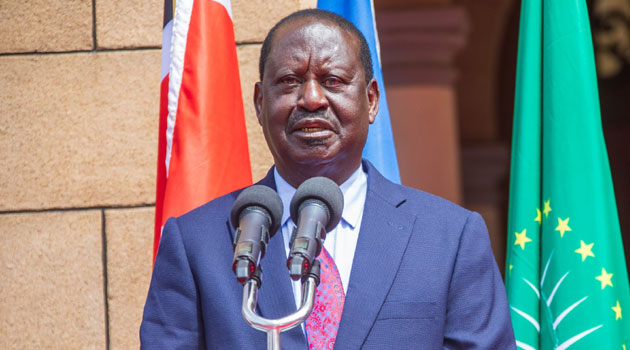
Raila Odinga has called for a national forum to bridge Kenya’s widening political divide, urging leaders across generations and sectors to come together for honest dialogue.
Speaking on Monday, the veteran opposition figure said the country stood at a dangerous crossroads.
“We must talk,” Odinga told reporters. “As someone who lived through and shaped the original Saba Saba movement, I believe our country needs a coming together of minds young and old for the sake of peace and progress.”
Odinga had been expected at Kamukunji Grounds on Sunday for Saba Saba commemorations a date marked by many as a symbol of Kenya’s democratic struggle. His absence raised eyebrows.
He later explained he was unable to reach the venue due to what he claimed were “strategically mounted roadblocks” on major roads across Nairobi.
But instead of focusing on the missed rally, Odinga used his platform to call for what he termed an “intergenerational conclave” a national forum involving political leaders, youth, religious institutions, and civil society to chart a path forward.
“What is to be done?” he asked. “We must listen to each other across the divide and agree on meaningful reforms. Our people deserve that.”
He stressed that the meeting must not be symbolic or politically convenient, but grounded in firm commitments, especially around reforming the police service.
“There can be no real peace without justice,” Odinga said. “We must address police accountability, transparency, and how the public relates to the men and women in uniform.”
His remarks come at a time of growing unrest. Protests have intensified in recent weeks, with youth groups taking to the streets over a range of issues from the cost of living to alleged state repression.
Calls for police reform have grown louder, especially following clashes between protestors and security forces. The government, meanwhile, has maintained that it is acting within the law to preserve order.
It remains unclear who will be invited to Odinga’s proposed dialogue or how the process would begin. Some critics see it as a political manoeuvre, while others view it as a much-needed step in diffusing tension.
“Let us not wait until it is too late,” Odinga warned. “This country belongs to all of us, and we must fix it together.”
About the Author