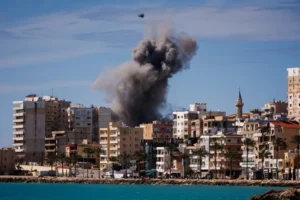


UK Prime Minister Keir Starmer is under intensifying pressure to recognize Palestinian statehood, as France commits to formal recognition within months and dozens of British lawmakers push for immediate action. The demand, led by members of Parliament’s Foreign Affairs Committee, follows growing international condemnation of the humanitarian crisis in Gaza. PM Starmer is expected to hold an emergency call later today with French President Emmanuel Macron and German Chancellor Friedrich Merz to discuss worsening conditions in the besieged territory.
In a statement released Thursday evening, PM Starmer called the humanitarian situation in Gaza “unspeakable and indefensible.” Starmer affirmed that Palestinian statehood was an “inalienable right” and reiterated his call for an immediate ceasefire, saying it would “put us on a path” toward eventual recognition.
However, PM Starmer has yet to commit to a specific timeline, consistently argued that the UK should grant recognition at a moment of “greatest impact” but has not defined when that moment will arrive. A newly published report from the Foreign Affairs Committee recommended the UK recognize Palestine “while there is still a state to recognize.” It was backed by all six Labour members and two Liberal Democrats on the committee, who argued that recognition should not be made conditional.
“The government cannot continue to wait for the perfect time,” the report cited. “An inalienable right should not be made conditional.”
Two Conservative MPs on the committee, Aphra Brandreth and Sir John Whittingdale, opposed that section of the report. They argued recognition must be tied to broader political progress, including the release of Israeli hostages and the formation of a Palestinian governing authority without ties to Hamas. The divide underscores the deep political sensitivity of the issue. While select committees often seek consensus, divisions on foreign policy matters are not uncommon.
More than 60 MPs signed a letter earlier this month urging PM Starmer to take immediate action. London Mayor Sadiq Khan publicly echoed that call on Wednesday. Liberal Democrat leader Ed Davey pressed the government to “recognize the independent state of Palestine now and take the lead on securing a two-state solution and a lasting peace.”
Green Party co-leader Carla Denyer described recognition as “the bare minimum,” while SNP Westminster leader Stephen Flynn said it was time for the Prime Minister to “do the right thing.”
Speaking Friday morning, Secretary for Science, Innovation and Technology Peter Kyle reaffirmed Labour’s manifesto commitment to statehood but said the move must be handled in a way that would “deliver long-term peace.”
France’s decision follows similar moves by Spain, Ireland, and Norway in 2024. These countries hoped formal recognition would add diplomatic pressure to end the conflict in Gaza. To date, 139 UN member states recognize Palestinian statehood, though most European countries and the United States have made recognition contingent on peace negotiations.
Israeli Prime Minister Benjamin Netanyahu rejected France’s stance, calling Palestinian statehood “a launch pad to annihilate Israel.” U.S. Secretary of State Marco Rubio called the decision “reckless.” Palestinian officials, on the other hand, welcomed France’s pledge, viewing it as a step toward broader international legitimacy.
In a related development, the UK joined 27 other nations in condemning the “drip feeding of aid” and the deaths of civilians seeking food and water in Gaza. Israel’s Foreign Ministry dismissed the criticism as “disconnected from reality.”
The MPs’ report also recommended replacing the U.S.-backed Gaza Humanitarian Foundation with a UN-led aid system, citing mistrust in the existing delivery mechanism. The committee further called on the UK government to clarify how indirect export of British-made components used in Israeli F-35 fighter jets aligns with international law. The government has maintained that those parts are supplied to international manufacturing partners, not directly to Israel.
As diplomatic urgency intensifies, Starmer faces a defining foreign policy test: whether to act on calls for immediate recognition or continue pursuing a measured approach amid complex geopolitical calculations.
About the Author