ANKARA – Google has admitted its earthquake early warning system failed to accurately alert people during the 7.8 magnitude earthquake that struck southeastern Turkey on February 6, 2023, killing more than 55,000 people.Ten million people within 98 miles of the epicentre could have been sent Google’s highest level alert – giving up to 35 seconds of warning to find safety. Instead, only 469 “Take Action” warnings were sent out for the first 7.8 magnitude quake. The alert, designed to trigger a loud alarm and override a phone’s silent mode, could have given users up to 35 seconds to seek safety. Most did not receive it.
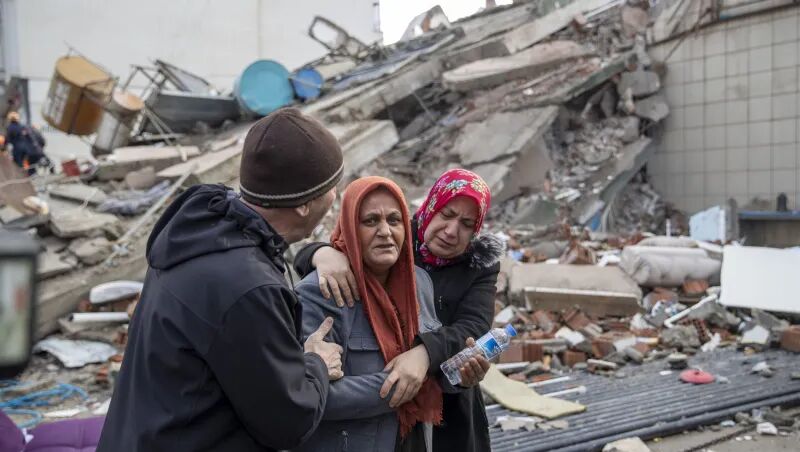
Instead, Google confirmed that around 500,000 people were issued the less serious “Be Aware” notification, which only provides information about lighter shaking and does not override device settings. The weaker alert is not designed to wake sleeping users a critical information dissemination failure considering the earthquake struck at 4:17 a.m. while many were still in bed.
“We continue to improve the system based on what we learn in each earthquake,” google spokesperson said in a statement. But the damage had already been done.
Google’s Android Earthquake Alerts system (AEA) operates by detecting seismic activity through motion sensors in Android phones. When it picks up strong tremors, it sends alerts based on the expected magnitude and shaking.
However, the system misjudged the first quake’s intensity, initially estimating it between 4.5 and 4.9 on the Moment Magnitude Scale far below the actual 7.8 magnitude measured later. As a result, the alert that could have saved lives was not delivered to the majority of those in harm’s way.
A second quake later that day was also underestimated. Although Google sent more serious alerts to 8,158 users and “Be Aware” messages to just under 4 million, the alert still failed to reach most of those exposed to heavy destruction. Months after the disaster, Google researchers simulated the original quake again using an updated algorithm. That test correctly triggered 10 million “Take Action” alerts and another 67 million “Be Aware” messages across the broader region.
“Every earthquake early warning system grapples with the same challenge tuning algorithms for large magnitude events,” Google defended its alert system.
The flaws in the warning system only came to light more than two years after the quake, when Google researchers published their findings in the journal Science. The delay has drawn criticism from experts and victims’ advocates.
Elizabeth Reddy, a specialist in disaster response, said, “I’m really frustrated that it took so long. We’re not talking about a minor issue people died.”
The system had been live in Turkey at the time, with Android devices accounting for more than 70% of the mobile phones in use across the country.
Press teams that visited impacted cities months after the earthquake found no users who recalled receiving the loud, screen-blocking alert that should have warned them before the ground shook.
Experts warn that overreliance on private tech systems like AEA can lull governments into a false sense of preparedness. Harold Tobin, a seismic expert, cautioned, “Some countries might calculate that if Google’s doing it, they don’t have to invest in national systems.”
Google has stressed that AEA is meant to support not replace official early warning programs. Still, the admission of its failure in Turkey raises new concerns about how tech companies handle real-time crisis alerts in regions lacking robust national infrastructure.
As of today, AEA is live in 98 countries. The press has requested Google for official reports on how the system performed during the 2025 Myanmar earthquake but has not received a response.
In Turkey, where entire neighborhoods collapsed in seconds and rescue teams raced against time, the absence of an early warning for millions remains a painful memory.
A grieving mother in Kahramanmaraş told reporters last year, “If someone had just warned us just a few seconds I might still have my son.”
About the Author