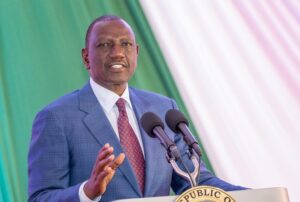
Prime Cabinet Secretary Musalia Mudavadi has issued a stark warning to political leaders ahead of Kenya’s 2027 general elections: stop the tribal talk and don’t export ethnic divisions to the diaspora.
Speaking in Kajiado County, Mudavadi said some leaders were inciting Kenyans abroad along tribal lines, risking the social cohesion of diaspora communities and undoing years of national healing.
“You fly all the way to the United States just to spread division. That is not leadership,” he said. “In a foreign land, your best friend is the Kenyan next to you—not their tribe.”
He added that Kenya must never return to the days of the 2007–2008 post-election crisis, which claimed more than 1,400 lives and left deep ethnic wounds. “We negotiated peace for 42 days. Let’s not forget that,” he said.
Gachagua Responds from Worcester: “Whom Do They Want Me to Talk To?”
But former Deputy President Rigathi Gachagua, who recently addressed Kenyans in Worcester, Massachusetts, dismissed Mudavadi’s concerns as misplaced.
“I heard Musalia accusing me that I’m only talking to my people—whom does he want me to talk to?” Gachagua asked, to applause from a largely Kikuyu crowd.
He defended his meeting with Kenyans in the U.S., saying the diaspora had wrongly been assumed to have “forgotten their traditions and culture.”
“When they saw our people dancing to songs from the 60s and 70s by Mugithi maestro Samidoh, they were shocked. They realised this community is united globally—and that’s what they fear.”
Gachagua claimed he was being unfairly singled out for bringing his community together abroad.
“They’re accusing me in every meeting. Saying I’ve exported tribalism to America—just because I spoke to my people,” he said. “But unity is power. If we remain united, no one can challenge us. No one will interfere with our businesses.”
A Battle of Messages, A Nation Watching
The back-and-forth lays bare the growing tension between Kenya’s senior political figures as the country inches closer to a new election cycle.
While Mudavadi warns against sowing discord, Gachagua champions ethnic solidarity.
The contrast highlights the delicate balance between cultural pride and political tribalism—a fault line that has often defined Kenyan politics.
Mudavadi also urged politicians to model better behaviour for younger generations.
“Gen Z is watching us,” he said. “If leaders speak hatred and insult each other, what are we teaching our children?”
Looking Ahead
As 2027 draws nearer, the tone of Kenya’s political discourse is already heating up—not just at home, but thousands of miles away in diaspora communities. Whether unity or division prevails may depend less on slogans and more on what leaders choose to say—and where they say it.
About the Author