TURNBERRY – The United States and European Union have reached a sweeping new trade deal, cutting through months of tension with a 15% tariff on Euroopean exports to the U.S., following talks between President Donald Trump and European Commission President Ursula Von der Leyen. The agreement was finalized Sunday at Trump’s Turnberry golf resort in Scotland. U.S President Trump had previously threatened to impose a 30% tariff beginning Friday. The compromise now puts the rate at half that level, with exemptions for selected goods and promises of major investment from Europe into the American economy.
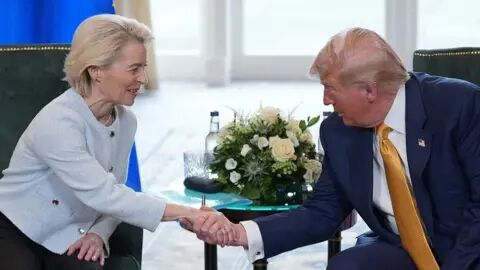
“This is the biggest deal ever made,” President Trump said after emerging from a private meeting with European Commission President Von Der Leyen. “We have reached a deal. It’s a good deal for everybody.” European Commission President Von der Leyen echoed these sentiments. “These were tough negotiations, but we now have a framework that brings predictability,” she said. “It’s a huge deal.”
Under the new arrangement, the EU will face a flat 15% tariff on goods entering the U.S., with certain products excluded. These include aircraft components, specific chemicals, and selected agricultural goods. European Commission President Von der Leyen said more technical details would be worked out in the coming weeks.
President Trump said the EU also committed to increase investments in the U.S. by $600 billion over three years. That funding will target American energy and defense sectors, with $750 billion earmarked for purchases of liquefied natural gas, oil, and nuclear fuels.
“This will help Europe reduce dependence on unreliable energy partners,” European Commission President Von Der Leyen stated, referencing past concerns over Russian energy influence.
Some sectors such as alcohol, particularly French wines and Dutch beer remain in limbo, with tariff decisions pending. President Trump confirmed that the existing 50% U.S. tariffs on imported steel and aluminum would remain unchanged. The trade deal comes after prolonged standoff between Washington and Brussels over trade imbalances. In 2024, the U.S. imported about $606 billion in goods from the EU and exported $370 billion. Trump has repeatedly cited that gap as unfair to American workers.
“I don’t want the U.S. to keep losing,” President Trump told reporters. “We’re done being taken advantage of.”
European Commission President Von der Leyen said the deal would “rebalance” the trading relationship. EU officials had previously argued the imbalance was overstated, citing the EU’s high purchase volume of U.S. services.
Sunday’s announcement followed a weekend of private golf outings and informal meetings. Trump was joined by his son Eric and other family members during his stay in Turnberry. The deal was finalized shortly after Trump played his second round of golf at the resort.
The response across Europe was measured. France’s European Affairs Minister Benjamin Haddad said the deal offered “temporary stability” but called it “unbalanced,” noting that some French sectors had received exemptions while others did not.
Irish Prime Minister Micheál Martin said the higher tariffs would still make trade “more expensive and more challenging.” Ireland exports more goods to the U.S. than any other EU nation.
German Chancellor Friedrich Merz posted on social media that avoiding a trade conflict was critical for his country’s economy. “Stable and predictable trade relations benefit everyone,” he said.
Italy’s Prime Minister Giorgia Meloni welcomed the agreement but said Rome would review the full text before endorsing it.
The agreement is still subject to ratification by EU member states. Their ambassadors are scheduled to receive a briefing from the Commission on Monday. British Prime Minister Keir Starmer is also expected to meet Trump later this week during the president’s tour of Scotland.
The White House estimates the new tariff regime will generate $90 billion in annual revenue based on last year’s trade figures. While the EU did not match the UK’s more favorable 10% tariff rate, the 15% cap is viewed by many European officials as a better outcome than the 30% hike that loomed days earlier.
Although both leaders framed the deal as a win, critics in Europe say the EU gave up more ground than it received. Still, the deal averted an escalating trade war, at least for now.
“We avoided a real economic hit today,” EU diplomat said. “But this is just the beginning. The details will determine the impact.”
About the Author