
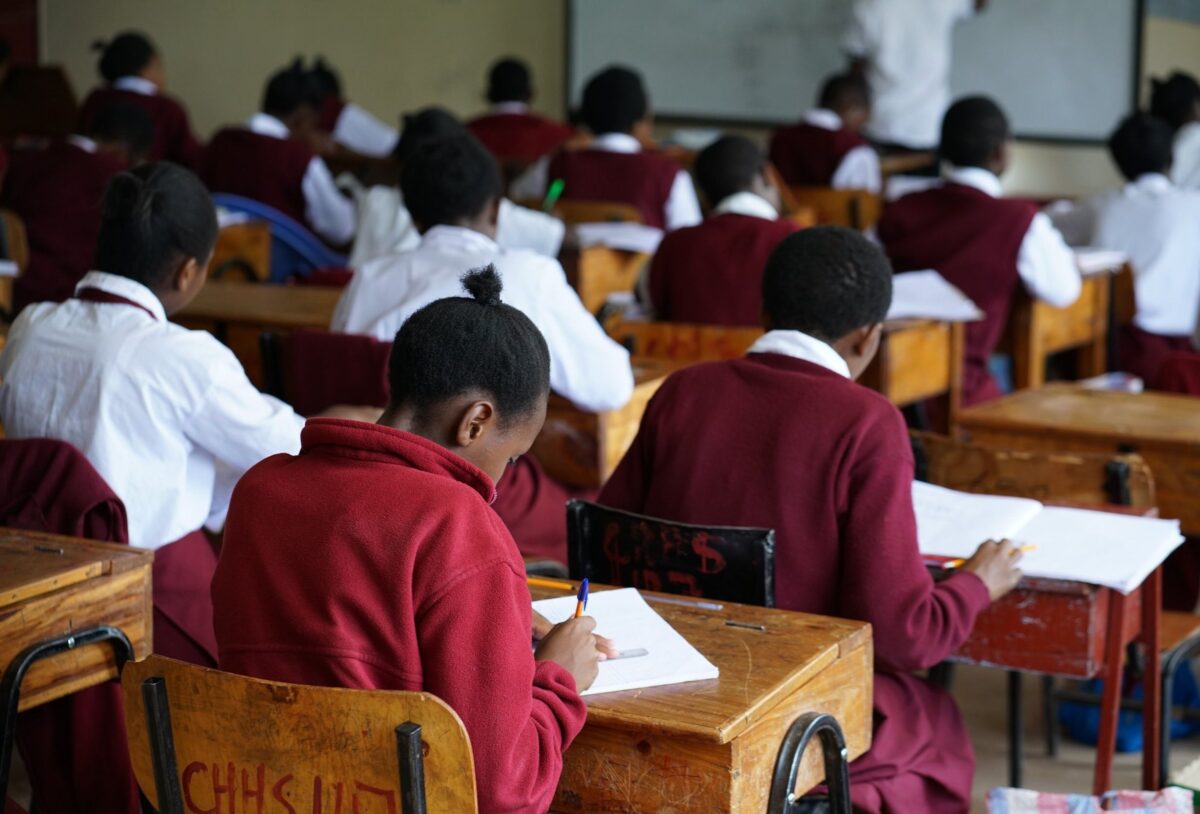
Nairobi — Ministry of education is under immense strain due to massive staffing shortages, poor infrastructure, limited access to digital learning, and underwhelming student performance. These are the key findings of the newly released State of Education in Kenya report.

The report, compiled by Zizi Afrique Foundation and Usawa Agenda, presents a stark picture of the country’s education sector. It cites a national shortfall of about 100,000 teachers and teacher training colleges.
According to the data, most schools across the country operate with far fewer facilities than required. Sanitation remains a serious concern. The national average is 66 boys per toilet and 62 girls per toilet, more than double the Education Ministry’s recommendation of 30 boys and 25 girls per toilet.
At the report’s launch, Dr. John Mugo explained, “We still lack basic WASH infrastructure. The new curriculum also demands laboratories and access to technology, but most schools are not ready.”
The report also raises alarms about early childhood education. While enrollment rose 5% from 2018 to 2021, staffing in ECDE centers dropped sharply from 92,359 teachers in 2019 to 69,561 in 2022. The function, now managed by county governments, lacks uniformity in quality and access.
Dr. Emmanuel Manyasa noted, “Early childhood education is expanding, but not equally. In Mandera, over 51% of children are out of school, compared to 1.3% in Kisumu and 1.8% in Nakuru. The disparity is too wide.”
Performance in primary schools also reflects deep inequality. Only 4 out of 10 Grade 4 learners can read and understand a Grade 3-level English story. In arid and rural counties like North Eastern, the numbers drop to 2 in 10 learners.
The push for digital literacy under Kenya’s Competency-Based Curriculum (CBC) remains poorly supported. As of December 2024, just 21% of public junior school teachers had training in STEM subjects. A third of junior schools had no STEM teacher at all, and only 48% of learners had access to a science lab.
To address these gaps, the Teachers Service Commission hired additional STEM teachers in January 2025. But the report emphasizes that physical tools alone won’t fix the problem teachers must also be well-prepared to guide students through modern, tech-centered lessons.
The report points to an urgent need for stronger coordination among local communities, the private sector, civil groups, and public agencies.
“This can’t just be a government issue,” the report states. “Improving Kenya’s public education will take shared effort and consistent support at every level.”
The data delivers a clear message: Kenya’s education sector is at a breaking point and without serious investment and reform, future generations will be left behind.
About the Author