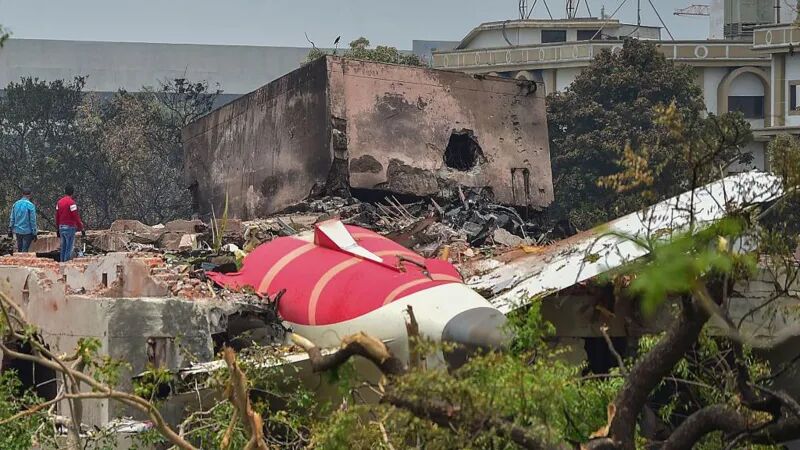
Ahmedabad — Investigators examining the crash of Air India Flight 171 have uncovered chilling cockpit audio that deepens the mystery behind one of the country’s worst aviation disasters. The Boeing 787 Dreamliner crashed just seconds after takeoff from Ahmedabad last month, killing 241 people on board and 19 others on the point of collision leaving only one survivor Vishwas Kumar.
According to preliminary findings released Saturday, both fuel control switches were suddenly flipped to the “cut-off” position moments after liftoff. The move, typically done only after landing, starved both engines of fuel and caused total power loss.
The cockpit voice recording captures one pilot asking, “Why did you do the cut-off?” followed by the other replying, “I didn’t.” The voice identities have not yet been confirmed. At the time of departure, the co-pilot was flying while the captain was monitoring.
The switches were quickly returned to the normal position, and both engines began relighting. The left engine began to regain power. The right, while restarted, never reached full thrust. Less than 40 seconds after takeoff, the aircraft crashed into a residential area near the airport.
Flightradar24 data confirms the aircraft reached only 625 feet before losing signal 50 seconds after takeoff. The crash site is located near a doctors’ hostel, just minutes from Sardar Vallabhbhai Patel International Airport.
Experts say the cockpit switches are designed with multiple safeguards. The levers are guarded, require manual lifting to unlock, and are nearly impossible to activate together by accident. This adds confusion to what may have triggered both to shut off simultaneously.
“The design of these fuel switches makes accidental deployment extremely unlikely,” said one aviation investigator familiar with the system. “Pulling both would take two deliberate actions.”
The report rules out mechanical failure, stating that the switches functioned normally and that fuel samples from the aircraft’s tanks were “satisfactory.” This casts doubt on earlier theories of fuel contamination.
The Federal Aviation Administration (FAA) had flagged a related issue in 2018, warning that some aircraft had the locking features on fuel control switches disabled. The warning applied to Boeing 737s but noted similar switches exist on the 787 model that crashed. Air India, however, did not carry out the recommended inspections since the advisory was not mandatory.
Questions now center on whether a pilot intentionally or unintentionally flipped the switches or if an electrical malfunction occurred.
Shawn Pruchnicki, a former airline crash investigator, said the audio raises urgent questions. “You don’t normally see a dual engine shutdown without a serious cockpit alert. And yet, there’s no indication either pilot realized what had happened until the engines were already losing power.”
Peter Goelz, a former U.S. air safety official, added, “One pilot clearly shut the fuel off. The voice recorder proves it happened, but it doesn’t explain who did it or why.”
Investigators are working to match voices on the audio with the crew, using those who personally knew the pilots to help identify the speakers. Without voice attribution, conclusions remain limited.
Authorities are also pushing for cockpit video recorders. A camera view inside the cockpit, now common in cars but still absent in commercial airliners, could have revealed who touched the switches.
The aircraft’s Ram Air Turbine (RAT), a small emergency generator, deployed automatically during the power loss, confirming that both engines had failed. The landing gear was also still extended, suggesting the crew had no time to retract it before impact.
A pilot familiar with the Dreamliner explained that gear retraction normally happens around 200 feet, and the process finishes by about 400 feet. “They never got the chance. When both engines fail at that altitude, it’s not just a shock it’s paralysis. You have seconds to act, and there was no time.”
Data suggests the crew tried to recover. The left engine showed signs of spooling up. The right engine, though reignited, failed to produce enough thrust in time. Investigators believe the pilots attempted a restart sequence but were overtaken by the rapid descent.
No advisory has been issued for the 787 or its GE GEnx-1B engines, and no evidence currently points to a technical defect. Still, experts remain focused on the cockpit environment and possible system glitches.
Capt. Kishore Chinta, a former investigator, questioned if the aircraft’s control unit could have triggered the shut-off. “Could the cut-off switches have been tripped electronically, without human input? If that’s possible, it needs urgent attention.”
As families of victims demand answers, authorities stress that the voice recordings and aircraft systems data will be crucial. A full transcript and voice identification are still pending.
For now, the report confirms this: both engines were deliberately or mistakenly shut down mid-air. The mystery is who did it and why.
About the Author