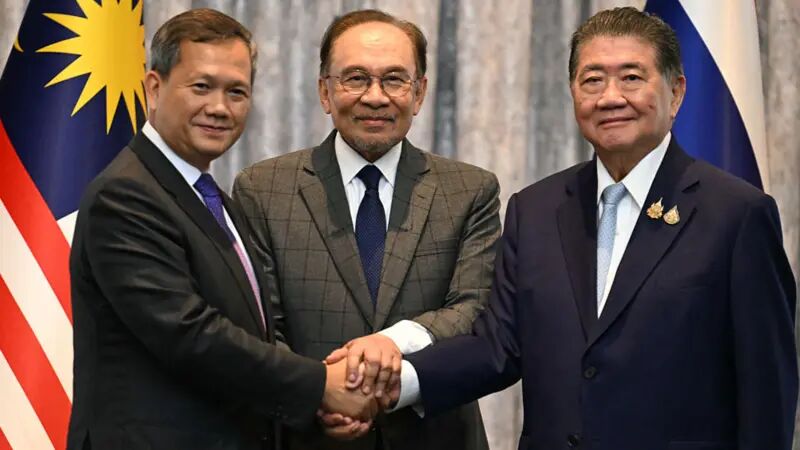
PUTRAJAYA – Cambodia and Thailand have agreed to an immediate and unconditional ceasefire, bringing a pause to five days of intense fighting along their shared border that has left at least 33 people dead and forced over 300,000 to flee their homes. The agreement was reached Monday evening in Putrajaya following high-level peace talks hosted by Malaysian Prime Minister Anwar Ibrahim. The ceasefire is set to take effect at midnight local time.
The conflict, rooted in a century-old border dispute, escalated dramatically on July 24. Thailand accused Cambodian forces of launching rockets into Thai territory, prompting retaliatory airstrikes. Both governments traded blame, but neither side denied the significant civilian toll.
Cambodian Prime Minister Hun Manet, speaking after the closed-door session, called it “a very good meeting” and urged both countries to “start rebuilding trust and confidence.” He thanked Thailand for its “constructive engagement” and acknowledged the roles played by Malaysia, China, and the United States.
Thai Prime Minister Phumtham Wechayachai confirmed Thailand’s support for the ceasefire. “We negotiated in good faith and are fully committed to honoring the terms,” he said.
The talks gained urgency after U.S. President Donald Trump publicly linked trade negotiations with both countries to a cessation of hostilities. In a post on Truth Social, Trump said he told the leaders, “We’re not going to make a trade deal unless you settle a war.” He claimed that by the time the calls ended, “they wanted to settle.”
Malaysia’s Prime Minister Anwar Ibrahim, who chaired the discussions under the mandate of ASEAN, said the ceasefire is “a vital first step toward restoring peace and security.” He confirmed that both sides agreed to resume direct communication between their prime ministers, foreign ministers, and defense officials.
According to a joint statement, military commanders from both countries will hold an informal meeting Tuesday at 7:00 AM. A formal session involving defense attachés from ASEAN member states will follow on August 4 to lay out a verification and implementation framework. Details of that mechanism remain unclear.
The latest violence is tied to an unresolved territorial row, first ignited in 2008, over the Preah Vihear temple area along the border. Although the International Court of Justice awarded the site to Cambodia in 1962, its surrounding land has remained contested.
Fighting in recent days saw shelling and rocket fire exchanged across the border, with civilians in provinces like Oddar Meanchey and Surin caught in the crossfire. Aid agencies reported tens of thousands of people seeking shelter in temporary camps as the conflict intensified.
Despite the ceasefire deal, observers warned that tensions could resurface if troop withdrawals and demilitarized zones are not quickly enforced. Ceasefire breaches have occurred in the past, often triggered by localized disputes between patrol units.
Both the U.S. and China dispatched observers to the talks, signaling international concern over the potential for further instability in Southeast Asia.
PM Hun Manet closed his remarks by emphasizing the human cost. “This agreement gives hundreds of thousands on both sides the chance to return to normalcy,” he said.
The ceasefire now hinges on both governments’ willingness to follow through with de-escalation steps in the days ahead.
About the Author