LOS ANGELES — For a second night, Los Angeles is under curfew. The streets are tense. Police sirens pierce the air. Protesters, now well into their sixth day, say they are defying a crackdown they view as unjust and dangerous.
At the centre of the unrest is a federal immigration sweep that began last Friday. Since then, nearly 400 people have been arrested across the city. Among them, 330 are undocumented migrants, according to police. Others face charges ranging from assault to obstruction, including one for attempted murder of a police officer.

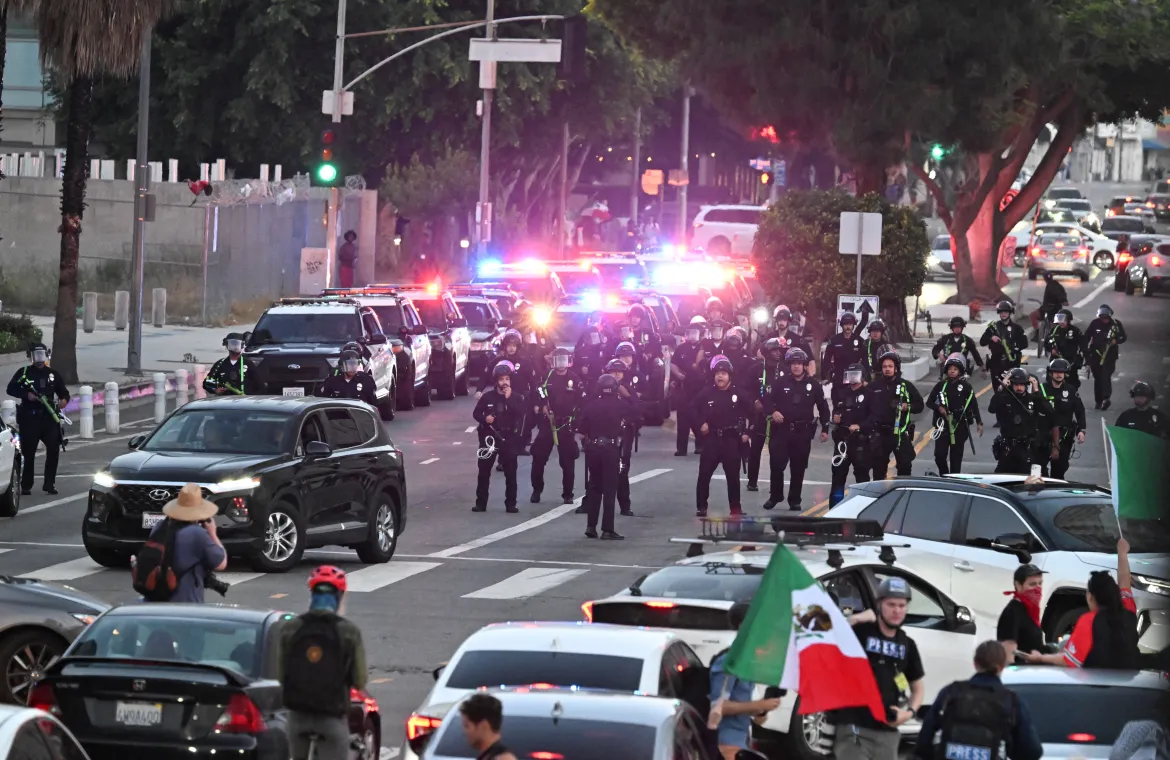
As dusk fell on Wednesday, hundreds of demonstrators gathered near City Hall before being dispersed by police as the 8 p.m. curfew came into effect.

“We’re here because our communities are under siege,” said 27-year-old Sofia Ramirez, who marched with a small group holding handmade signs. “They’ve turned our neighbourhoods into war zones.”
A City in Lockdown
The city’s mayor, Karen Bass, says the curfew is necessary but temporary. In a post on X (formerly Twitter), she wrote that the order was designed to “stop bad actors who are taking advantage of the president’s chaotic escalation.”

At a news conference earlier in the day, she was more direct.
“A week ago, everything was peaceful,” she said. “Things began to spiral on Friday when the raids started. The fear spread fast.”
Bass accused the federal government of provoking unrest.
“This feels like a national experiment,” she said. “How far can the federal government push into local power without resistance?”
Heavy Presence, Heavier Questions
The federal response has been swift and sweeping. More than 4,000 National Guard troops are now stationed across the city, alongside 700 Marines. While they cannot make arrests, some have been authorised to detain individuals until local police can respond.

“They’re here to shield federal personnel during operations,” said Major General Scott Sherman, the officer overseeing the deployment. “We’re not here to police the streets.”
Yet that’s precisely how many residents say it feels.
“We don’t know who’s in charge anymore,” said Marta León, who lives near MacArthur Park. “I see soldiers in my alley, but I don’t see justice.”

Prosecutors have charged two men with hurling Molotov cocktails at police officers one of several violent clashes reported since protests began.
The Los Angeles Police Department confirmed that two officers were injured overnight. A total of 203 people were arrested for failing to disperse. Seventeen were taken in for violating the curfew. Others were found carrying weapons.
“Some of the images coming out make it look like a city-wide crisis,” said Police Chief Jim McDonnell. “It’s not. But the tension is real.”
A Political Flashpoint
The White House remains firm. President Donald Trump defended his decision to send troops to Los Angeles, calling it an effort to prevent the city from being “conquered by a foreign enemy.”
His remarks drew sharp criticism from California Governor Gavin Newsom.
“He chose escalation over dialogue,” Newsom told reporters. “This is not liberation. This is an assault on our democracy.”
Newsom, a Democrat seen as a likely presidential hopeful, warned that other states could soon face similar federal incursions. “This isn’t just about California,” he said. “It’s a test for the entire nation.”
At a Senate hearing in Washington, Defence Secretary Pete Hegseth said the deployment was “lawful and constitutional.”
“These actions were taken with the sole aim of restoring order,” Hegseth said. “Nothing more.”
‘The Fear Is Palpable’
As of Thursday morning, the curfew remains in place across a one-square-mile stretch of downtown Los Angeles. Whether it will be lifted or expanded remains unclear.

In the meantime, protesters say they’re not going anywhere.
“We’re staying in the streets,” said activist Chris DuBois. “Because that’s where our voices are heard.”
With federal troops on standby, state leaders digging in, and thousands of residents refusing to back down, Los Angeles finds itself once again at the crossroads of policy and protest its future uncertain, but far from quiet.
About the Author