
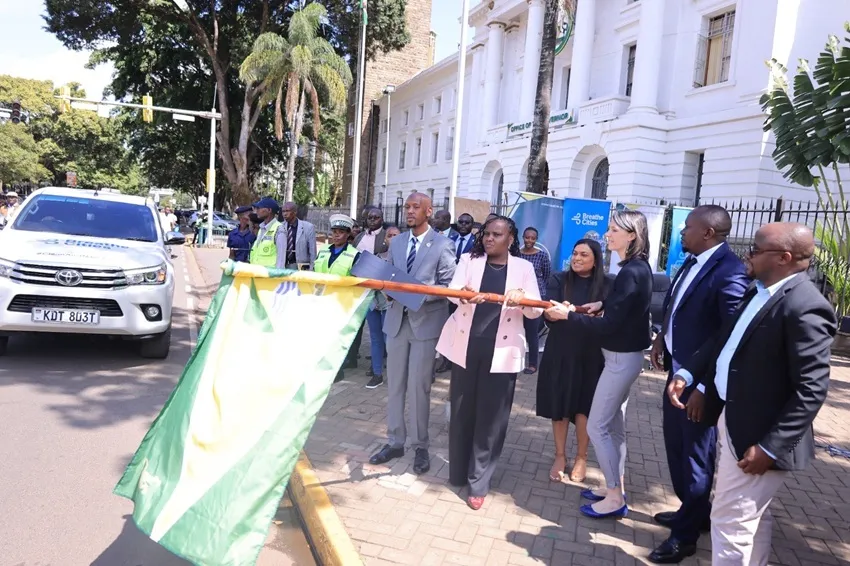
Nairobi – In a major push to tackle one of its deadliest invisible threats, Nairobi has launched its first city-owned air quality monitoring network. Officials say the move will transform how the capital fights pollution and protects its people.
“This is a turning point,” Governor Johnson Sakaja said in a statement. “It’s a practical step to ensure every Nairobi resident breathes cleaner, safer air.”
The city has begun installing 50 advanced air sensors across key locations. Thirty-nine are already in place. They will collect real-time data on pollutants and alert authorities to trouble spots. The network, officials say, will help shape smarter policy and possibly save lives.
Maureen Njeri, Nairobi County Executive for Green Nairobi, didn’t mince words during the launch on Wednesday.
“Air pollution is a silent killer,” she said. “It harms our children, our elderly, and the soul of this city.”
Njeri added that Nairobi had long been “flying blind,” with limited access to localised pollution data. That changes now.
“These aren’t just gadgets. They are our eyes in the sky,” she said. “They’ll show us where the dangers are, and give us the evidence to act.”
Why Now?
The statistics are sobering. According to data shared by Njeri, fine particle pollution in Nairobi is four times higher than what the World Health Organization recommends. In 2019, air pollution was linked to around 2,500 premature deaths in the city.
More recent estimates suggest at least 268 people in Nairobi still die each year due to polluted air. Ten percent of the city’s health budget goes to treating related illnesses, a 2024 UN Environment Programme report found.
“This isn’t just an environmental issue it’s a public health crisis,” said Geoffrey Mosiria, Chief Officer for Environment in Nairobi County. “The data from these sensors will let us zero in on the worst-hit areas and respond more effectively.”
Global Ties, Local Impact
The monitoring network is part of the Breathe Cities initiative, a global programme backed by the Clean Air Fund, C40 Cities, and Bloomberg Philanthropies. Nairobi joined in 2024, one of only 14 cities worldwide chosen for support.
Dr Victor Indasi, who leads the programme in Kenya, called the sensor rollout “an inspiring milestone.”
“This is about evidence, not guesswork,” he said. “Now Nairobi has the tools to design cleaner air policies that are grounded in data and in reality.”
The programme aims to cut air pollution in participating cities by 30% by 2030, compared to 2019 levels. It also offers technical help to draft new clean air rules and an action plan tailored to each city’s needs.
Next Steps
With the sensors going live, officials say the priority now is using the data well.
“This network empowers us to act faster and smarter,” said Njeri. She noted that the city will use the findings to guide urban planning, raise public awareness, and strengthen regulations.
The county is also tackling waste another major source of pollution. Mosiria confirmed that Nairobi has already closed an illegal dumpsite along Likoni Road and is looking at waste-to-energy alternatives.
“Instead of dumping, we want to recycle and convert waste into something useful,” he said.
A Model for the Continent?
As Africa’s cities grow, so do their air pollution challenges. Nairobi’s approach could offer a template for others. While the road ahead is long, city officials say this step marks a serious commitment to clean air.
“Cleaner air isn’t just about the environment,” said Njeri. “It’s about saving lives and improving the quality of life for every Nairobian.”
And for once, the city has the tools and the data to do it.
About the Author