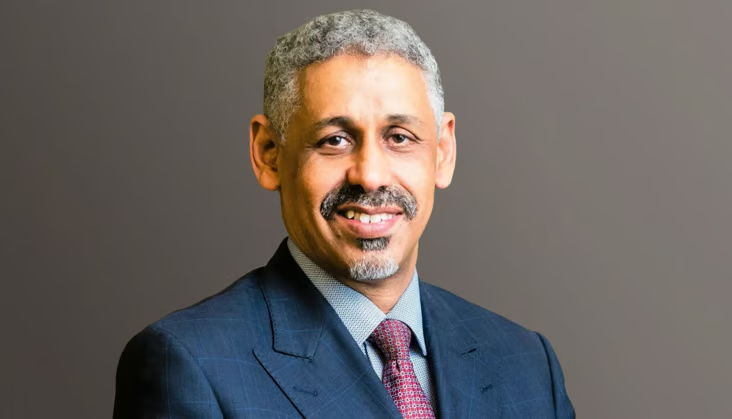
NAIROBI – In a closely watched vote in Abidjan, Mauritanian economist Sidi Ould Tah was elected on Thursday as the ninth president of the African Development Bank Group, succeeding Nigeria’s Akinwumi Adesina, whose decade-long tenure ends in September.
Dr Tah, a former finance minister and career development banker, clinched the presidency in the third round of voting with 76.18 percent. His rivals, Zambia’s Samuel Maimbo and Senegal’s Amadou Hott, finished second and third respectively.
The result came as a surprise. Maimbo led the first round with more than 40 percent of the vote, while Tah trailed behind. But by the third and final ballot, support had shifted sharply in Tah’s favour.
The Bank announced the outcome in a brief statement on X (formerly Twitter), confirming Dr Tah’s election during the annual meetings in Côte d’Ivoire. According to AfDB rules, a candidate must win either a majority of voting power or at least 50 percent of both regional and non-regional votes. Voting power is tied to each country’s shareholding in the institution.
Long Career in Finance
Dr Tah, 63, brings nearly four decades of experience in African finance. Most recently, he served for ten years as president of the Arab Bank for Economic Development in Africa (BADEA), where he is credited with doubling the bank’s assets and improving its credit rating.
Before that, he was Mauritania’s Minister of Economy and Finance, as well as a top adviser to the president and prime minister. His early career included posts at the Islamic Development Bank, the Arab Authority for Agricultural Investment and Development, and Nouakchott’s city council.
In an interview with media before the election, Dr Tah said he would draw on his “360-degree view” of development to lead AfDB from day one. “I don’t need a learning curve,” he said.
He holds a PhD in economics from the University of Nice Sophia Antipolis in France, with earlier degrees from Paris Diderot University and the University of Nouakchott.
A Vision Focused on Finance, Climate and Technology
Dr Tah’s pitch to shareholders was built around four goals: mobilising over $400 billion annually for African development; reducing the cost of public borrowing; supporting small and medium enterprises; and investing in climate-resilient infrastructure.
He has also promised to deepen the bank’s engagement with emerging technologies. While at BADEA, he launched a venture capital fund to support African start-ups. At AfDB, he plans to expand this work and has spoken in favour of using blockchain in mainstream finance.
“We need to embrace technology. We need to be ambitious and willing to take risks,” he said, insisting that Africa should not lag behind other continents in digital finance.
On Debt and Africa’s Global Voice
Dr Tah takes a cautious view on Africa’s mounting debt. Instead of more borrowing, he wants to see public-private partnerships fund large infrastructure projects. He also argues that Africa’s poor credit ratings often assigned by foreign agencies do not always reflect the continent’s economic realities.
“The AfDB should challenge this narrative,” he said. “We have the legitimacy and the convening power to speak on behalf of Africa in global economic forums.”
His message appears to resonate with leaders frustrated by the heavy hand of institutions like the International Monetary Fund in African economies. Some African officials believe the AfDB, as the continent’s premier multilateral lender, should take a stronger position on macroeconomic policy.
Dr Tah’s election follows a race that included five candidates. Chad’s Mahamat Abbas Tolli and South Africa’s Bajabulile Tshabalala were knocked out in earlier rounds.
Outgoing president Akinwumi Adesina, a former Nigerian agriculture minister, will step down in September after serving the maximum of two five-year terms. His leadership saw AfDB through the COVID-19 pandemic, while also expanding the bank’s capital base and influence.
Dr Tah’s presidency will begin at a time of mounting challenges: high public debt, youth unemployment, and climate pressures. He insists, however, that the moment calls for bold ideas.
“We can’t afford business as usual,” he said. “Africa is ready and so is the bank.”
About the Author